Monday, December 04, 2006

Tuesday, October 17, 2006
Saturday, August 12, 2006
My Musical Resume by Debbie Naples
1964–1980: sing Broadway show tunes and Negro spirituals in family car
1966–1974: learn almost the entire musical score to My Fair Lady
1967: play kazoo, self-taught
1967:have kazoo confiscated due to complaints from Italian grandmother
1967–1969: perform with Our Lady of Peace school choir
1967–present: get in trouble several times for banging drums too hard in local music stores
1968: attempt but fail to whistle Andy Griffith Show song
1969: steal father’s harmonica, play it, break it
1969: sing in several variety shows with father (including Broadway hits “Okalahoma,” “Stop the World I Want to Get Off”)
1970–1973: perform with Lordship School Choir, sing two solos
1971: receive tin whistle from Irish grandmother
1971: lose tin whistle when Mother throws it out the window of family car
1972: enroll in flute lessons, 5th grade
1972: get dismissed from flute lessons when teacher realizes I can’t read music
1972: join 5th-grade recorder club without knowing how to read music
1973: acquire own harmonica
1974: learn to read music from Mother
1974–1976: sing soprano with
1975 pass out on scaffolding while practicing with Johnson Junior High choir
1976: play with brother’s trumpet
1976: am forced to take free piano lessons at prep school while others play baseball outside
1976–1980: sing soprano with Lauralton Hall school choir
1978: abandon piano for swim team
1978: play and break sister’s clarinet
1980: sing with
1980–1982: take guitar lessons
1980–1983: sing in car alone frequently
1982: guitar teacher dies, guitar lessons end
1985: discover significance of Brandenburg Concertos
1985: date man who has FCC license
1986: attend Run–DMC concert
1987: watch drag queen sing selections from La Boheme in F-train station,
1990: purchase recorder at Costco, learn to play “The Jungle Book”
1994–2002: make repeated visits to Sam Ash Music,
1994: learn lyrics to song “4 Wet Pigs”
1997: assist in rewrite of My Fair Lady to My Fair Roshi, spring Zen retreat
1997: perform in My Fair Roshi
1997: have recurring dreams about playing violin
1999: try to learn Italian with singing language tape, create reputation at office
2000: receive guitar for birthday
2000: play new guitar only in secret, mixing Bob Dylan and Elton John’s lyrics
2001: refuse to participate in karaoke e of any kind
2002: memorize a few of MC Solaar’s greatest hits in French
2003: acquire copy of Macintosh Garage Band musical editing software and accidentally call it “Garbage Can”
2003: write own music with free loops from software and force friends to listen
2003: acquire copy of SoundTrack editing software
2003: use SoundTrack to chop up parts of Broadway musical Hair and make new rap tunes
2006: program cell phone mix tracks for exclusive rings
(Debbie Naples is a dabbler in many things. She lives all over the place, but recently admitted to keeping house in Connecticut.)


Thursday, August 10, 2006
Monday, July 31, 2006
Friday, July 14, 2006
Thursday, July 13, 2006
The Rambunctious Adventures of Jalasso Pei, part two
With the match suspended and the threat to her record averted, Jalasso returned to the peril of the moment: the wrath of her mother. A new wave of panic washed over her, and she dashed to the makeshift net to see if she could disentagle the knotted afghans and reposition the chairs from which they hung.
Miranda watched with vague interest while slowly packing her tennis gear.
“Need some help?” she asked over her shoulder after several moments. Jalasso had started in desperation to pull loose thick strands of yarn from the knit throws.
Jalasso glanced over at her. “Would you?”
“Ha!” Miranda laughed sarcastically. She stood and heaved her bulky saffron tennis bag over her shoulder. “You wish.” She headed for the door at the far end of Jalasso’s bedroom.
In frustration, Jalasso accidentally pulled loose several more strands of yarn from her mother’s expensive afghans. It seemed to her that at any minute the entire collection of knit items might unravel into one long, messy strand. She dropped the twisted mess as she watched Miranda striding toward the door. “Oh, yeah?” she shouted. “Well, next time we play, you’re going to wish something! That I’d stop kicking your skinny butt!”
She should have known from her long nine years of experience that just such a line would signal her mother’s entrance. It never failed that Mrs. Pei arrived always at the height of her daughter’s most outrageous exclamations. As the word “butt” left Jalasso’s lips, the heavy oak door flew open with a soft thud.
Jalasso leapt back a foot and covered her mouth involuntarily. Not because of the sudden terror her mother inspired, though she did. And not because it seemed very likely that she’d lose her court privileges for at least a month, though she probably would. But rather because the door to her room had just burst open with a thud, whereas it typically tended toward more of a crash. The difference between the sounds was accounted for by Miranda. She had just reached the door as Jalasso’s mother came in, and the door hit the girl square in the face.
Mrs. Pei’s reaction was less immediate. She had entered the room admonishing her daughter for her rambunctious, destructive behavior, for her rude treatment of her guest, and for her distinctly unladylike language. It took her a couple of seconds to process the details of the situation in Jalasso’s bedroom, and her tirade sputtered out as she took it all in. Jalasso stood still, eyes wide, hands over her mouth. Several of the antique throws looked in danger of being unraveled, and they were strapped to the delicately wroght chairs she’d hoped would downplay the sporty look of her daughter’s room. And finally, it seemed that little blonde girl Jalasso had a tennis rivalry with stood just inside the doorway. She was holding her nose and wailing in pain.
Mrs. Pei sputtered as she shifted her primary concern from confronting Jalasso about the broken window to kneeling down in front of the girl she’d evidently just hit in the face with the door.
Mrs. Pei held Miranda by the shoulders. “Oh, I’m so sorry, dear! I’m sorry! I didn’t know you were behind the door.”
Miranda continued to cry in high-pitched screams interspersed with long, low sobs. Mrs. Pei tried to pull the girl’s hands away from her face to see how badly she was hurt, but Miranda wouldn’t let her. She kept her whole face hidden, and her endless hours of tennis practice gave the little girl considerable upper body strength.
“Please, honey, let me see,” Mrs. Pei implored the girl. She disliked have to use a soft, mothering tone. Dealing with Jalasso’s unbridled energy and crafty willfulness had made such gentle measures so rare that they now felt false and foreign. But she had to cope with this situation as best she could. She didn’t think it would help to get stern or to overpower the girl.
Slowly, Miranda relaxed her arms, and Mrs. Pei drew her hands back. When she saw the girl’s face, she blanched. She tried not to react for fear of scaring her, but Miranda recognized the look of concern and uncertainty. She knew something was wrong.
Plus, it was hard not to notice the blood that dripped from her nose and now covered the bottom half of her face and both of her hands. Immediately, Miranda’s whimpering escalated into a series of high, anguished shrieks. Her hands flew back to cover her face and she sat down heavily on the floor, her tennis bag sliding off her shoulder and slumping to one side.
Mrs. Pei did her best to make soothing sounds, but Miranda seemed to be going into some mild form of shock. “Jalasso,” the woman whispered loudly, never taking her eyes off the injured child, “call down to Marble. Tell him your friend is hurt.”
Jalasso stood at the far side of the room, shifting her weight from one foot the other. She wanted to spring into action. She knew it was time. But for the time being, she felt incapable of moving. Things would just get worse from here, and she knew it. If only she could rewind things. Back to the match. To those last few returns. To that awful backhand of hers.
“Jalasso!” Mrs. Pei shouted in her best commanding voice.
The girls sprang into action, practically vaulting over her canopy bed toward her phone. She used the intercom function and heard the butler pick up as he always did in two rings, no more, no less.
“Marble!” she shrieked. “Mother’s calling for you. Miranda’s hurt!”
“Very good, Miss Jalasso,” Marble said in his unhurried, unflappable manner. “First aid or emergency?”
Wednesday, July 05, 2006
Saturday, July 01, 2006
The Rambunctious Adventures of Jalasso Pei, part one
Jalasso had hoped the additional insulation and pricey soundproofing of her room would do the job. She needed it to muffle steady footfalls and shoe squeaks, to dampen the sharp smacks of tennis balls bouncing off the floor, and to smother her outraged cries as Miranda scored sneaky points.
And maybe it had worked. But even so, even the best soundproofing did nothing to hide a shattered bedroom window. Especially when the bright yellow tennis ball Jalasso had so terribly mishit sailed out that window, a shimmering trail of glass in its wake. Not when the spherical missile fell in bright noontime daylight four stories to the family estate’s vast green lawn. And not when the blasted thing then bounced, hopped, and rolled to a stop only a few yards from where her mother stood, discussing the details of Jalasso’s upcoming birthday lawn party with the groundskeeper.
As Jalasso stood looking out the windows and saw her mother’s beautiful pale moon of a face turn and look up at her angrily, she knew she would never be able to talk her way out of this one.
“So is that the match?” Miranda asked from over Jalasso’s shoulder as they watched Mrs. Pei walk stiffly toward the house.
Jalasso leapt down from the window seat and yanked one of the long, flowing curtains over the broken window. The wind outside gusted, pulling the curtain toward the jagged hole in the glass.
“What do you think, Miranda?” Jalasso asked testily, looking around the room at the obvious damage their game had caused.
“I think yeah,” Miranda said in a light tone. “But I’m just saying . . .”
Jalasso barely heard her. She had begun to run around her enormous bedroom, righting objects knocked over during the game, kicking stray tennis balls into her garage-sized walk-in closet, tucking the racquet she had been using under the mattress of her canopy bed. She did all this by force of habit, because she knew full well she could never get that window fixed before her mother made the long trek up to the fourth floor and down the long corridors toward the wing of the house that contained Jalasso’s bedroom. Besides, how would she ever have explained the ball? And all that glass outside? The makeshift net of antique afghan throws strung between two Chippendale chairs in the middle of the room?
Suddenly, she spun back toward Miranda, who still stood by the window, her racquet gripped lightly in her left hand. She glared. “You’re just saying what?” Jalasso asked suspiciously.
Miranda shrugged. “You’re down a set.”
Jalasso’s mouth fell open in astonishment. “What a cheap win!” she exclaimed. “That’s what it means to you when my mother’s about to come in here and revoke all my court privileges for the rest of the spring?”
Miranda tried to look hurt, but the expression was so unnatural for her that she looked instead like she was just recovering from a bad sneeze. “Like you wouldn’t! You’re still counting that game when I had an allergic reaction to that bee sting!”
For a moment, Jalasso forgot about the impending doom of Mrs. Pei. “That was totally fair,” she said. “Forfeiting for medical reasons.”
“My throat was going to close up!” Miranda yelled.
Jalasso threw her hands in the air. “So you made the right decision!”
Miranda grinned triumphantly. “So now it’s your turn,” she said. “Do we continue the game, or are you going to forfeit?”
Jalasso jumped up and down several times in frustration. She stomped her feet. “Why can’t we play it later?” she whined.
Miranda looked at her bare wrist as if she had a watch on it. “It’s match time now.”
Jalasso stopped suddenly and let her shoulders drop. She felt defeated, and she wanted just to fall down on the floor.
“Forfeit?” Miranda asked. She twirled her racquet in her hand.
Jalasso looked up at her sometime-friend and her small face broke into a grin. Her dark eyes glared up from under her choppy bangs. “Fine,” she said, “we’ll play. It’s still your serve.”
It was Miranda’s turn to look sincerely outraged. “What?” she asked. “We can’t play now! Your mom is coming up here to ground you for the rest of forever.”
Jalasso feigned an unconvincing look of innocence. “We can’t play?”
Miranda shook her head at Jalasso’s stupidity. “Of course not!”
Jalasso grinned wickedly and pumped her small fist. “Okay, then,” she said. “If we can’t play, then I don’t forfeit. Game postponed due to weather.”
“There’s nothing wrong with the weather,” Miranda protested.
Jalasso nodded. “Well, it’s about to get really bad in here. Stormy, even.”
Miranda tossed her head in irritation and stomped toward her tennis bag to gather her belongings. “Fine, Jalasso, the game’s postponed,” she said icily. “But I’m writing down the score. We’ll play again when you can go out, in like ten years.”
[next chapter]
Saturday, June 17, 2006
Tuesday, May 02, 2006
Sunday, April 02, 2006
Thursday, February 23, 2006
Wednesday, February 08, 2006
are you sensing a theme?
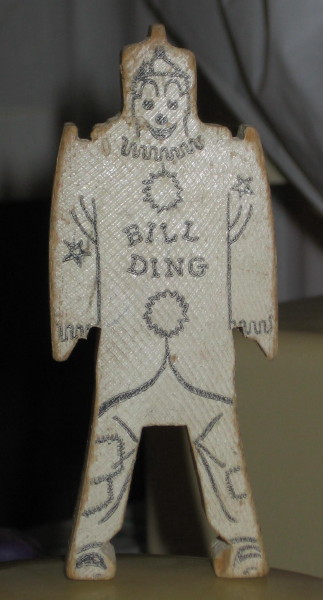 It's not my intention to start some kind of clown cult, I swear. I just grab pictures of things that draw my attention.
In this case, it's not the clown so much as the fact that this particular toy is one I'd completely forgotten about until my sister and I found it at my grandmother's house over Christmas. Who knows how many kids have been given nightmares by its like over the years?
This is just one of a whole collection of interlocking, vaguely human-shaped, wooden clowns. If you'll note, the shape of the thing's head is exactly the same as the negative spaces that fit into each of its shoulders. Very Escheresque. You're supposed to fit them together like they're insane, utterly still acrobats, from their stubby legs and squashed feet to their pointy shoulders and creepily truncated hands.
That's Bill Ding, folks. Isn't he great?
Monday, December 12, 2005
The Most Brilliant Performer in the Whole First Grade
“This doesn’t make sense,” Pancakes Dunst said to Meredith. But Meredith didn’t hear her. She was laughing too much. Up on the stage, Ramon and the skeleton continued arguing, escalating in volume and intensity. For everyone other than Pancakes and Mrs. Fletcher, the moment was pure, undistilled comedy, the very essence of humor. Ramon had gone to the root of all that is funny and presented it to his classmates for their grateful benefit. If Meredith hadn’t been snorting with uncontrollable mirth, she might have offered her opinion that Ramon was, frankly, a genius. The skeleton thing absolutely killed.
Just when the kids were getting used to the idea of Ramon’s arguing with a paper skeleton and began to quiet a bit, he changed up the act. He leapt to his feet, the skeleton outstretched before him in his left hand, and delivered a punch to its grinning skull with his right fist. “Nyih-ihh!” he screeched as the skeleton’s response. The children launched into fresh gales of laughter. He punched it again. The skeleton quivered with rage.
“This is nonsense!” Pancakes said, louder this time. She had a hard time making herself heard over the raucous appreciation of her classmates. She appealed to her teacher. “Mrs. Fletcher, why is this funny to everybody? It’s just stupid.”
The thirty-year-old Mrs. Fletcher, who most of children considered on the verge of her twilight years, looked down to where Pancakes sat on the fuzzy orange carpet. She adjusted her glasses nervously. Talking to Pancakes always made her a little nervous. The girl was so serious sometimes. She was too direct for a seven-year-old. “It doesn’t really appeal to me,” Mrs. Fletcher said. “But a lot of children love slapstick humor.”
“But…” Pancakes began. She faltered, searching for the words to explain what was confounding her. “But there’s no…there’s no, um…there’s no context,” she said. “You know what I mean?”
Mrs. Fletcher sighed inwardly. She taught first grade for many reasons, one which was that her students didn’t tend to engage in debates. She didn’t do well with debates, and she preferred to issue simple instructions and make behavior corrections. She didn’t want to talk about why certain kinds of humor needed context. “Pancakes,” she said, “it’s just a comedy act Ramon came up with. I don’t think he really wanted to give us any kind of message.”
On stage, Ramon had taken to trading blows with the skeleton. Its shaking rage had prompted it to attack him, which he indicated by fluttering the thing in his own face even as he shrank back from it. All the while, he continued to screech the skeleton’s annoyance. The kids couldn’t get enough.
Pancakes frowned. “But it’s a skeleton,” she said. “He’s arguing with it. My dad would say it was…Berman Ex.”
Mrs. Fletcher shook her head. “I don’t understand,” she said. “Berman?”
“It’s from the movies. Ingrid Berman?”
Mrs. Fletcher smiled in spite of herself. Pancakes thankfully revealed herself as a child at times. It made her teacher feel more in control of the situation. “I see. Bergmanesque. You’re thinking of Ingmar Bergman, Pancakes.”
“I thought her name was Ingrid. She’s been in a bunch of movies. My mother tries to look like her.”
“There is an Ingrid Bergman. She was a movie actress. But Ingmar Bergman, he was a movie director. Different person.”
“Well, whoever Bergman was, that’s like this.”
Before Mrs. Fletcher could respond, the kids burst out in a boisterous shout of hilarity. Ramon’s fight with his paper nemesis had gone from simple blows to desperate wrestling. The skeleton seemed to bowl him over, and Ramon fell to the floor. Then he tossed the skeleton away and made a comic lunge for it. Back and forth they went, pouncing on one another and rolling around the floor in simulated combat. Both Pancakes and Mrs. Fletcher looked on in terrified fascination as the volume level on the room went from an undulating roar to an outright explosion of amused screams.
Ramon appeared to have no plan for stopping his act. So long as he was getting laughs, he kept wrestling with the paper decoration, which was by now becoming rather tattered in the fight. He pretended to gain the upper hand, and he picked up the heap of paper and cardboard and tossed it into a dark green metal wastebasket on the far side of the small stage. But then he peered intently into the receptacle, and he quickly reached in to yank it out again, making it appear as if the skeleton had come back to life and attacked him anew. The crowd of children stayed with his every move, giggling and cheering and screaming with each new struggle. Mrs. Fletcher decided at last to intervene. The elderly twins who served as the school librarians had been shooting her disapproving looks ever since Ramon’s act first started.
“Okay, class!” Mrs. Fletcher said over the din of the children. “Thank you, Ramon! We need to wrap this up now, please!” The kids initially tried to ignore her, but she resorted to her loud double clap. That always brought the majority of the kids to attention. The volume she could get out of her two small palms was preternaturally loud, like the sharp snaps of high-powered firecrackers. The sound effectively stopped the show, and despite the fact that Ramon still thrashed about with the remains of his paper skeleton, the laughter died away with frightening suddenness. The twin librarians raised their eyebrows in unison. They wondered, also in unison, though of course they couldn’t know that, why Mrs. Fletcher hadn’t taken such remarkable charge much earlier.
Once the laughter died away, Ramon finally looked up from his exertions. He’d ripped one of his short shirt sleeves in his struggles with the skeleton, and the paper Halloween decoration had been reduced to a clump of wrinkled paper and folded cardboard. He grinned at his class. “Ramon and Ellie!” he shouted. He gave no other explanation, and since he hadn’t introduced his act beforehand, everyone assumed that the skeleton had been named Ellie. No one knew why, but then as Pancakes pointed out, no one really knew why anything onstage in the past ten minutes had occurred. Ramon retreated from the stage, but he stood uncertainly beside it and awaited instructions.
“Why ‘Ellie’?” Pancakes asked Ramon.
He shrugged.
“It doesn’t mean anything?” she asked.
“It’s my sister,” he said. “I named the skeleton after my sister. Ellie.”
Pancakes smiled. “Okay,” she said finally. “Then it all makes sense. I wish you’d told me that earlier.”
“What? You don’t know my sister.”
“No. About your act. I get the conflict now.”
“I don’t understand.”
“That’s okay. I do. That’s all I was worried about.”
Ramon said nothing more. Pancakes made him nervous. She was always saying things that he didn’t get, and then she didn’t explain them when he said he didn’t get them. None of the other girls were like that. But none of the other girls were named after a famous person, so maybe that’s why she was different. Anyway, he didn’t know what to say to her, and she didn’t seem to care.
Saturday, December 10, 2005
The Exclamatory Adventures of Pancakes Dunst
Through a Camera Lens, Darkly
How can the cleverest girl in the world save the planet if she can’t get out of her talk show bookings? Pancakes’s new publicist has filled her calendar with back-to-back TV appearances. If she can’t get more than a couple of minutes alone in the green room, then a crisis of vague but probably very weighty import might have serious but not entirely defined consequences for all humanity, or at least a good portion of it. And for pity’s sake, isn’t it possible for a girl to get some cucumber finger sandwiches and bottled mineral water while she’s in makeup? Is that too much to ask? Pancakes may now face her greatest challenge ever: Fame has gone to her head!
#18
Mass Marketed Plastic Halloween Candy Dish of Doom
“May I offer you a circus peanut?” the old woman asked, holding toward Pancakes a skull-studded plastic bowl full of dusty orange candy. What slender connection could these puffy confections have to the spooky going-on around town? Why are elderly spinsters, creepy merchants, and glassy-eyed housewives offering up handfuls of unwrapped candy? Who are the bicycle-riding prankster vigilantes who keep appearing around town? And what’s the meaning of the unlicensed carnival that’s just encamped on the other side of the county line? Is it all just meaningless imagery concocted to sell a product? Horrors!
#19
Valley Near a Mountain, With a Lake Nearby and Trees … Plus Some Clouds
Max Feldenblum’s cloying landscape paintings, for years consigned to walls along cafeteria lines, gain overnight fame when a wealthy eccentric begins buying his work. The movement his work inspires, Slapdash Expressionism, quickly becomes the toast of the art world and a popular new fad. As dense, oversized art magazines dissect the implications of Feldenblum and his followers, middle-class American families flood understaffed art stores for brushes, canvases, paints, and palettes in order to create their own haute hackwork But Pancakes Dunst sees something in the pictures that looks askew. Are those really “happy little woodland deer” Feldenblum’s painting, or might they be alien satellite receivers?
#20
The Triumphant Return of Happily After All
The reasons may be unknown, but the results are all-too-real for when someone manages to steal the last ten minutes of every big-studio movie in history. Film, magnetic tape, and digital formats worldwide lose any trace of the classic climactic scenes. Large-scale battles, daring car chases, fights to the death, and sweeping acts of romantic love all disappear. A tough-talking group of Midwestern independent filmmakers claims responsibility, but if they can’t even get their own continuity straight, how could they possibly orchestrate a scheme as complicated as this? Pancakes notices that the indie directors are wearing promotional T-shirts for a new, corporate-backed kid’s feature. Why would these auteurs want anything to do with a piece of fluff like Maggie Callow and the Sweaterpants? Even their deep sense of outsider irony can’t account for it.
Friday, December 09, 2005
Not Part of the Lesson Plan
Have you ever found yourself thrown together with a group that was basically dysfunctional? A bunch of people that collectively was just disruptive? The problems couldn’t be pinned on just a few people. There was something about the way they worked together somehow. Or worked against each other. A sum greater than its parts, in a way. In a bad way.
Yeah, so that’s my afternoon commercial art class. For two hours, five afternoons a week, I help to create a monster. Most of the students are in other classes of mine too, and none of them is reall a problem. And you guys know me. Would you ever think I was part of a bad crowd … other than yourselves I mean. But get the lot of us together, and we flagrantly and regularly break rules, talk out of turn, interrupt lectures, make inane requests, and—always, always, always—“talk with our neighbor.”
Our teacher Mr. Anson gets mad at us almost every day. Sometimes he sends people to the principal. Sometimes he suspends minor privileges or assigns ridiculous assignments in frustration. We never fail to piss him off, and we’ve gotten used to the way his face turns a very dark red when he’s really angry. We recognize what it means when his voice cracks slightly. We’ve become very familiar with the degrees of his anger over the course of this year.
So when we all came in to class at two today, we were surprised that Mr. Anson had planned a kind of “encounter session” for us. We all had to push our work tables to one side and pull up chairs in a big circle. Then he got down to it.
The whole year, he said, had been getting “worse and worse and worse.” We all needed to talk about that. He was going to talk while we listened, and then he would listen while we talked. We would fix this thing together, he said. We had to. It couldn’t go on like it had been, so we were all going to fix it together.
So we did like he said. He went over all the usual problems with our “getting out of hand.” He named a lot of events. Becky and Tonya and Melissa gossiping all the time. Doug and Robert humming heavy metal songs back and forth at each other. That one afternoon when almost everybody asked for special permission to go to the restroom … which we knew was kind of against the rules but that he felt like he had to keep giving into after making a couple of exceptions. Shavonda and Marquita’s way of asking random questions just to break their own boredom during still-life drawing exercises. I was kind of surprised at how many examples there were. I wish I’d been taking notes, because some of them were funnier than I remembered. But after about half an hour, he finally finished and invited us to talk.
After all that, though, nobody really wanted to talk. A couple of people who felt like lesser offenders made some vague comments. I didn’t know what to say. Then some more people started to pipe up about the problems with our teacher-class interaction. Some of what they said was a little stupid (“I just don’t feel like I’m at home, you know what I mean?”), some of it was insensitive (“Like, how are we supposed to get what you’re talking about when you say it the way you say it?”), some of it was almost insightful (“It’s not that we don’t like you. It’s just that you’re the teacher”).
Then things took a really weird turn. I guess what we were saying was more than Mr. Anson had bargained for. He started to look really upset, but not veiny and red the way we’re used to. Before we knew what was happening, his eyes got all watery, and then he suddenly buried his face in his hands. He sobbed, “I’m sorry, kids!” and then got up and ran out of the room. We all just sat there. Robert the metalhead laughed. Deann the cheerleader hissed, “It’s not funny!” and he shut up and looked kind of ashamed.
Mr. Anson eventually came back in about five minutes, and then we proceeded for the rest of the hour. I still doubt it will really help for more than a week or two. That second part of the discussion wasn’t nearly as interesting. Something strange had happened and everybody knew it. The more interesting part was what happened in the time Mr. Anson was gone.
“God, ya’ll, I don’t know,” Deann said. “We should do something for him.” I’m thinking, Yeah, we should be a decent class and stop giving him so much shit all the time. But we don’t know how to do that. We’re not capable of such decency. Because together we’re a mob.
Then people started agreeing with her, even though they couldn’t possibly care that much about Mr. Anson after all the crap they’ve been giving him for months ... that we’ve been giving him, I mean. But now they were talking about getting him flowers or a cake or maybe a cookie bouquet or just a card. They wanted to show how much they cared. But nobody could really agree on the right kind of sentiment after your teacher breaks down. Does Hallmark make a card with the right message? Get Well Soon? It’s Your First Breakdown? Hope the Medication Helps?
Finally we let the thing drop and just sat there. Every once in a while, somebody would wonder out loud what we should do. What would the school expect us to do? How long should we wait before we went to tell someone that our teacher ran out of the room crying?
By the time Mr. Anson came back, we had stopped talking about the idea of getting him a gift. I’m pretty sure we all were thinking “Oh, we’ll just be a better class. What better gift could we give him?” That’s the kind of Hollywood sentiment we’ve all learned to have whenever we don’t have a map for a situation. So we’d try harder. We’d fix this thing. We had to.
So I give us two weeks. Listen closely in the halls of B building in the next couple of months. If you hear a grown man bawling down one of the halls, be nice to him. We’ve been very mean to the poor bastard. And we’re really, really sorry.
Monday, November 21, 2005
The Hair-Raising Adventures of Pancakes Dunst!
Midnight Clambake on Rich Boy Island
During the America's Cup races, Pancakes and crew are blown wildly off course to a remote island. But instead of teeming with noble natives or tacky tourists, the place is populated by wealthy young white men! What is the secret behind their late-night beer busts, their dismissive comments about world affairs, and their primitive wargames? Pancakes vows to learn the truth. If only she's in time to save the bookish boy the other swaggering heirs call Piggy!
#14
Win a Dream Date with John Updike!
At the Norman Mailer Invitational, fighting young novelists meet to match their muscular prose against the toughest literary competitors in the world. Covering the event for the school paper, Pancakes Dunst falls in with a reporter from a glossy teen magazine. Soon she's barred from the event for helping to organize an unsanctioned swimsuit competition between some of the most gifted wordsmiths of the day. Yet when controversy breaks out over the authorship of a prize-winning novella, only Pancakes Dunst, the cleverest girl in the world, can cut through the Gordian knot. If only someone hadn’t stolen it from the trophy case!
#15
Alright, Mr. Rajagopal, I’m Ready for My Closeup
Asked to appear in a new film by director Sanjay Anil Rajagopal, Pancakes travels to Nova Scotia to try her hand at acting. But soon emergency meetings on the General Agreement on Tariff and Trades have led to angry strikes by fishermen worldwide. While the shortage of smoked salmon at the catering tables creates panic on the set, an escalation in fish piracy threatens to destabilize global seafood markets. Pancakes Dunst likes a good shrimp cocktail as much as the next cleverest girl in the world, but what to do? Mediate a divisive trade issue to end the immediate crisis, or get her screentime while allowing the market to find its own economic balance? No matter what she chooses, one thing is clear: Craft services will continue to use that stringy imitation crab meat she hates.
#16
Pancakes Dunst vs. the Sense of Detached Irony
Markets are plummeting! International tensions are rising! The environment hovers on the brink of disaster, political abuses run rampant, and all the summer movies are blatant vehicles for branding and merchandising! Yet the world’s population seems resigned to it all. Can Pancakes Dunst raise the level of discourse? Will the dark humor and exaggerated understatement finally cease? Might she divert global catastrophes by waking up the world’s leaders to the mess they’ve made? And what does it all matter—I mean, ultimately?
Saturday, November 19, 2005
Many Several Thousand Words
But that seems to be a time when my dad went kind of shutter happy, in part because he was secretly freaking out about my mother leaving her domestic life and going back onstage. I don’t know why he ever thought she'd be satisfied sticking around the homefront and playing happy homemaker. From what I can tell, no one else ever really bought it, even Mom. It just wasn’t in her nature. It’s like if I tried to be a diplomat or something. It’s not like I wouldn’t know how to begin, but it’s just not how I’m wired. International incidents would ensue.
Of all these pictures, my very favorite one is from our Easter party. Dad got Mom to help him plan it, and they went all out: a full lawn party with tents and ribbons and balloons. I don’t even know where all the kids they invited came from. Most of their faces are unfamiliar to me now. But there in the middle of the proceedings is me, hoarding a basket of toys and candy about three times bigger than I was.
But that’s not even the best part. The best part was our Easter bunny.
Mom had hired one of the actors from her show to come out for the day and mingle with the kids while dressed in a fuzzy bunny costume. He didn’t just run in and get us all excited, the way people in funny animal costumes usually do. It was an immersive experience. He hung out and played with us and told stories. He even helped us hunt for the harder-to-find eggs, because excited little kids have absolutely no attention span. I remember us finding brightly colored, rotting eggs in the yard all summer.
Since the bunny was there most of the day, just like the other adults he had access to the open bar on the patio. Most actors I've known can't turn down good alcohol. I think they’re afraid they’ll never be able to afford it themselves. The Easter bunny was no different, and he got pretty tipsy. Plus, it was an unusually warm spring that year, and those big fuzzy costumes get really, really hot. Sometime around two o’clock, it finally all got too much for him. The bunny fell over and passed out.
That would have been freakish enough for most kids, seeing the Easter bunny collapse. You can see just how much so on the faces of the kids who were in the immediate area when he went over, because Dad kept snapping pictures of the whole thing. This series contains one of my very favorite pictures ever: Seconds after the actor inside the rabbit costume collapsed, the huge, fuzzy animal head popped off and and rolled down the gentle slope of the lawn. Its oversized eyes stared in wonder, its toothy smile remained fixed. It was amazing and surreal. And how often do you get those kinds of pure moments? Okay, maybe when you're four you get them all the time, but this one was still special. Plus I have the pictures.
There are a few things that year's pictures don’t show, however. Those are probably as important—or more important—than what they do show. The main thing they don’t show is much of my mom. She’s there occasionally. For the Easter party, for some other big holiday events. But she’s a guest star, not part of the regular cast. I’m in there, the star. And Dad, his assistant, family friends, the household staff. When you look over the whole collection of shots, it's clear that Mom appears less often than, say, our cook.
Mom had taken a new role in a small musical. She'd been away from the stage for a couple of years, and she'd started showing signs of depression. So a new project seemed like it would be a good distraction. But the thing really took off, and she ended up being away from home more than expected. The commute got to be a problem, and more and more often she ended up staying at her old apartement in the city. The show’s run kept getting extended. “Just a couple of months” became “just another month or so” until a whole year had gone by Mom became a stranger in the house.
I’m sure this was all very good for Mom. She was born to the stage, I've been told. I’m not going to contradict public opinion by suggesting otherwise. But I was a four-year-old who only knew that whatever was going on in the city was a lot more interesting to my mother than I was. I don’t remember feeling that way, but I have some evidence that's what was going on. Some people have memories of their feelings at that age. I have pictures and stories.
Besides the remarkable absence of my mother in the hundreds of photos chronicling that year, what also stands out are the stories about my animal hallucinations. In hindsight, it seems obvious that I was so young that I wasn't able to distinguish between what was real and what wasn’t. But I know from what little I do recall that I wasn't making things up. I might have a vivid imagination, but I've never been one not to take credit for it. So even though I know for sure that these things couldn’t have happened, they still seem pretty real to me.
First there was the time that I was playing out on our lawn. We had these huge patches of tiny white flowers that kept popping up all over the lawn during that spring. I liked playing in them, but they attracted a lot of bees. One afternoon when some of my friends were over playing, someone got the idea of capturing some bees so we could make a bee village. We’d stomp bees when they landed on the flowers, and then someone would scoop them up with a cup and take them to some trenches we'd dug out in the sandbox. The injured bees would crawl around the trenches, providing our village with citizens. Kids are so cruel.
Eventually I stomped a bee when no one was around to help me. When I looked down to where my white canvas tennis shoe was flattening the grass and flowers, all of a sudden I saw the bee reach around the edges of my rubber sole and pull himself out! The bee didn't wriggle its way out from under my shoe the way you might imagine. I saw these two cartoon-like black arms, all muscley, reach out from under the shoe. The bee pulled himself free, and then he flew right at me, superhero-style, and stung me on the cheek. When I told the adults about it, but they thought I was just upset. I could hear them laughing when they told the story later.
A month later we were staying at the family beach house. I’m pretty sure Mom was supposed to come stay out there with us, but the pictures don’t lie. She wasn’t there. And it’s not like Dad ever forgot to point the camera at her. Next to me, she was his favorite subject, but the the photos of those weeks at the beach show only a smiling little girl, her doting father, and a few friends swimming, building sand castles, and clustering around bonfires.
One afternoon I was playing in the upstairs playroom. All the windows in the house were open to catch the ocean breeze, and a lot of flies had been getting in. Dad had repeatedly warned me to be careful of the horseflies, because they might bite. I'd been keeping an eye on every fly that came my way, watching for the dreaded horsefly. Then I saw a particularly large fly land on the window sill, and I knew I'd finally seen it. It had a fat, shiny fly's body, six thin hairy legs, and transparent wings, but its huge compound eyes were poking out of a narrow horse's face on a long neck. It wouldn't have seemed any weirder if it whinnied. I ran downstairs as fast as I could to tell Dad. I’ve ever really completely forgiven him for laughing so hard.
Everyone thought these were isolated incidents, and they made for good stories. But then I had two more hallucinations a few months later as my mom's absence from home went on and on. One night, I woke up suddenly and had the feeling that something was in the room with me. It was very dark, and I couldn't see much, but I was convinced that a bear had gotten into my bedroom. Its huge, broad shape shifted uneasily in the corner near the door. It sniffed the air, trying to get the scent of my fear. If it sensed my moving, it would kill me. But if I didn't escape, it would also kill me. I spent what felt like hours slowly inching my way off the bed, breathing shallowly and shaking as I made my way out the window and onto the balcony. I was out there for at least an hour before Dad found me shivering outside in the cold.
At that point Dad began to see a pattern. The bear thing came up shortly after my parents had had a big argument, and he knew I’d witnessed some of that. He made an appointment with a child psychologist and told my mom that he thought she'd been away for long enough. I don't know how she felt about the whole thing, but she showed up at the house that weekend. There's no way she could have been there if she hadn't turned her role over to someone else, so I guess she was convinced my problems were pretty serious.
Both my parents wanted to be there to take me to the doctor. We spent a couple of days together while we waited for my appointment, but despite how normal they wanted to make things, that's not how it seemed. Mom was back, but mostly out of guilt. And Dad was as happy as always to have her around, but he could always sense her desire to get away and resented it. We had some marathon icy silences around the house in those days, and those don't get filled in just because the cartoons on TV are turned up too loud.
The day before my appointment, I was watching afternoon kid's shows. The local station added a lot of between-show filler, kind of a Kid’s Show Helper, including a fake news report about an escape at the local zoo. Animals were everywhere, they said, and they instructed kids to be on the lookout for wild animals outside their windows for the rest of the day. It kept me at the window on animal watch all afternoon. Every once in a while they’d interrupt the shows with updates about the capture of some of the animals. But there was a lone kangaroo who had bounced so far away, they said, that they might not ever catch him.
I was completely convinced about the rogue kangaroo. They showed maps on TV of where he had been spotted, and even though there’s no way I would have been able to read a map, I was sure he was heading my way. Every minute or so I’d go over to the third-story window of the playroom to see. I was sure I’d be the one to catch him. I just had to keep looking.
Then while I was staring out the window into the distance, all of a sudden there he was! Not some little figure in the distance. No, instantly I found myself staring straight into the kangaroo’s eyes. He'd leapt straight up from the ground, bobbed into view for just a split second, and then disappeared again. All I knew about kangaroos was that they jumped really high and far. The whole thing made perfect sense to me. Of course a kangaroo could jump thirty feet in the air.
And of course a kangaroo could hop away so fast that you couldn't even see him go. I kept staring out the window, looking as far as I could see, but the kangaroo was gone. There was no sign of him, as if he'd never even been there. It made me very sad, and I decided not to tell my parents about it. Even now I remember how bewildered that kangaroo looked when he stared me in the face. The poor thing didn’t know where to go, but he knew for sure that he didn’t want to be caged anymore.
Saturday, November 12, 2005
Act Two
It was best that Pancakes didn’t recall it, actually, because if she had, she would have been unable to avoid interpreting the incident as symbolic. She would have recognized it as the moment that set in motion many of the things that came later: her fascination with her Broadway star mother and their strained, distant relationship … her close, comforting relationship with her father and her tendency to overlook him … the seemingly predetermined career path she’d take between her mother’s connection with stagecraft and her father’s facility with the written word … her fixation on dazzle and spectacle … her ill fit in the company of others. And it all would have been too much, coming from her. She would have suggested that it hinted of destiny. Later, feeling intellectually foolish, she would have rescinded that statement entirely—all the while secretly believing it was true. If nothing else, she would at some point have written a play about it, and it seems almost a certainty that the ponderous heavy-handedness of the material would have consigned it to being one of her lesser works.
The moment in question occurred just a month after Pancakes’s second birthday, when she and her father flew for a two-week stay in London. There her mother, Lorinda, was nearing the end of a long run onstage in a popular revival of Lillian Hellman’s two-play cycle about a corrupt, avaricious family in the Old South. The flight so jetlagged Pancakes that she fell deeply asleep her first full night in England, while she and her father sat in the front row of the theater before the beginning of that evening’s performance. The play had begun its second act before she awoke for more than a few drowsy moments, and when she finally began to look around the darkened theater inquisitively, she eventually focused on the action taking place on stage. There, wheeling around with girlish delight and almost glowing with beauty and grace, was her mother! Pancakes was so surprised and excited that she cried out for her. A few members of the audience laughed quietly, a few others scowled in annoyance, and her father quickly hushed Pancakes before she yelled again. Lorinda, whose professionalism was honed up to and beyond a fault, seemed not to miss even a beat. Her sole glance of motherly concern toward the front row was so well disguised by her character’s animated mannerisms that no one other than she realized that she’d heard her daughter calling out for her at all.

 Posts
Posts