Saturday, July 01, 2006

The Rambunctious Adventures of Jalasso Pei, part one

Mishit

Jalasso had hoped the additional insulation and pricey soundproofing of her room would do the job. She needed it to muffle steady footfalls and shoe squeaks, to dampen the sharp smacks of tennis balls bouncing off the floor, and to smother her outraged cries as Miranda scored sneaky points.

And maybe it had worked. But even so, even the best soundproofing did nothing to hide a shattered bedroom window. Especially when the bright yellow tennis ball Jalasso had so terribly mishit sailed out that window, a shimmering trail of glass in its wake. Not when the spherical missile fell in bright noontime daylight four stories to the family estate’s vast green lawn. And not when the blasted thing then bounced, hopped, and rolled to a stop only a few yards from where her mother stood, discussing the details of Jalasso’s upcoming birthday lawn party with the groundskeeper.

As Jalasso stood looking out the windows and saw her mother’s beautiful pale moon of a face turn and look up at her angrily, she knew she would never be able to talk her way out of this one.

“So is that the match?” Miranda asked from over Jalasso’s shoulder as they watched Mrs. Pei walk stiffly toward the house.

Jalasso leapt down from the window seat and yanked one of the long, flowing curtains over the broken window. The wind outside gusted, pulling the curtain toward the jagged hole in the glass.

“What do you think, Miranda?” Jalasso asked testily, looking around the room at the obvious damage their game had caused.

“I think yeah,” Miranda said in a light tone. “But I’m just saying . . .”

Jalasso barely heard her. She had begun to run around her enormous bedroom, righting objects knocked over during the game, kicking stray tennis balls into her garage-sized walk-in closet, tucking the racquet she had been using under the mattress of her canopy bed. She did all this by force of habit, because she knew full well she could never get that window fixed before her mother made the long trek up to the fourth floor and down the long corridors toward the wing of the house that contained Jalasso’s bedroom. Besides, how would she ever have explained the ball? And all that glass outside? The makeshift net of antique afghan throws strung between two Chippendale chairs in the middle of the room?

Suddenly, she spun back toward Miranda, who still stood by the window, her racquet gripped lightly in her left hand. She glared. “You’re just saying what?” Jalasso asked suspiciously.

Miranda shrugged. “You’re down a set.”

Jalasso’s mouth fell open in astonishment. “What a cheap win!” she exclaimed. “That’s what it means to you when my mother’s about to come in here and revoke all my court privileges for the rest of the spring?”

Miranda tried to look hurt, but the expression was so unnatural for her that she looked instead like she was just recovering from a bad sneeze. “Like you wouldn’t! You’re still counting that game when I had an allergic reaction to that bee sting!”

For a moment, Jalasso forgot about the impending doom of Mrs. Pei. “That was totally fair,” she said. “Forfeiting for medical reasons.”

“My throat was going to close up!” Miranda yelled.

Jalasso threw her hands in the air. “So you made the right decision!”

Miranda grinned triumphantly. “So now it’s your turn,” she said. “Do we continue the game, or are you going to forfeit?”

Jalasso jumped up and down several times in frustration. She stomped her feet. “Why can’t we play it later?” she whined.

Miranda looked at her bare wrist as if she had a watch on it. “It’s match time now.”

Jalasso stopped suddenly and let her shoulders drop. She felt defeated, and she wanted just to fall down on the floor.

“Forfeit?” Miranda asked. She twirled her racquet in her hand.

Jalasso looked up at her sometime-friend and her small face broke into a grin. Her dark eyes glared up from under her choppy bangs. “Fine,” she said, “we’ll play. It’s still your serve.”

It was Miranda’s turn to look sincerely outraged. “What?” she asked. “We can’t play now! Your mom is coming up here to ground you for the rest of forever.”

Jalasso feigned an unconvincing look of innocence. “We can’t play?”

Miranda shook her head at Jalasso’s stupidity. “Of course not!”

Jalasso grinned wickedly and pumped her small fist. “Okay, then,” she said. “If we can’t play, then I don’t forfeit. Game postponed due to weather.”

“There’s nothing wrong with the weather,” Miranda protested.

Jalasso nodded. “Well, it’s about to get really bad in here. Stormy, even.”

Miranda tossed her head in irritation and stomped toward her tennis bag to gather her belongings. “Fine, Jalasso, the game’s postponed,” she said icily. “But I’m writing down the score. We’ll play again when you can go out, in like ten years.”

[next chapter]

Monday, June 26, 2006

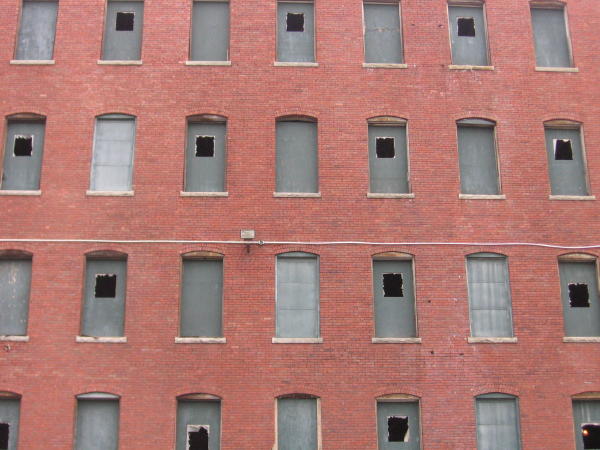
ready to repurpose

(Oxford Street at Beacon, Somerville, MA)

Tuesday, June 20, 2006

subjects of the foodmaster

(Johnny's Foodmaster, Beacon St., Somerville, MA)

el cubano curioso

(Havana Alma de Cuba, Christopher Street, NYC)

the sly, gentle subtlety of the industrial age

(Amtrak Metroliner, northbound, New Haven, CT)

Saturday, June 17, 2006

available immediately: used hitchhiking sign, ESL format

(Aquarium Station, Blue Line, MBTA, Boston, Mass.)

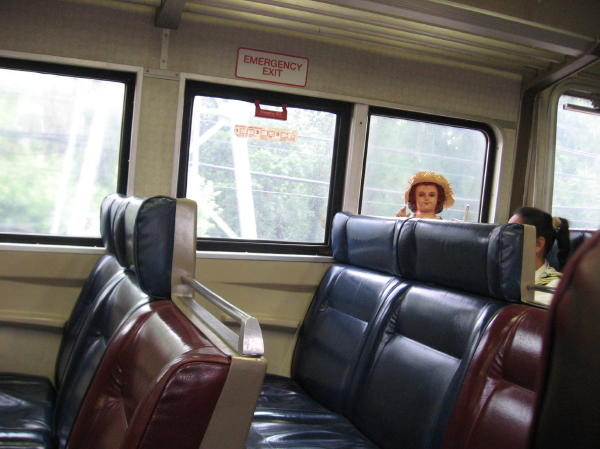
nuestro nino del tren

(Long Island Railroad, eastbound, New York)

Wednesday, June 14, 2006

Attack of the Perilous Page Count and the Deadlines of Doom

(or, No, I Do Not Think I'm Shel Silverstein)

I'm writing a book, and it seems I can't stop
It may not succeed, but it also can't flop
It can't be assessed, it can't be reviewed
For flat characters or for writing that's crude

I'm working on chapter three hundred and two
Right after the part with the crazed kangaroo
The treasure has yet to be found by the guy
With the Freudian fears and the patch on his eye

A publisher bought the whole thing on spec
I bet he now wishes he'd just stopped the check
Originally it was just s'posed to be
A treatise on life by the Caspian Sea

But since I got started, I can't seem to close
I keep rambling endlessly on with my prose
The plot just unravels, complications abound
And I think in truth there's no end to be found

For instance, I'm not sure the captain's alive
He's rumored to have been cut down with a scythe
But he was the one, least so far as I know
Who had the birth papers of Lady Gateux

And if I can't think of some way that he might
Have survived the storm on the Isle of Wight
Then Old Ragged Tom and his young urchin band
Are banished forever from Gondwanaland

Which means that Michel can never depose
The evil young prince who's stolen his clothes
The prince will at last get to marry Corinne
And sit on the throne, but I can't let him win!

The upshot is that there are more scenes in store
Plus desperate editor's calls to ignore
And what can I say to respond to his pleas?
This manuscript's now grown up way past my knees

I keep writing faster and faster to find
Some miracle to get me out of this bind
A birth or a death, a sword in a stone
Most anything now that my deadline is blown!

This epic must somehow be brought to an end
The way that it's sprawling I just can't defend
I've toyed with the cheats, but they all seem too pat
"Deus ex machina"—what the hell's that?

I could have it all be a mere endless dream
Like Winsor McKay and his Welsh rarebit fiend
Or a Joycean trick: just end where you start
But that admits there was no tale to impart

I have to decide, and I must do it soon
Ignore all the plot holes and wrap up by June
I must finish this, and with no backward glance
If I'm ever to get my final advance

Monday, June 05, 2006

Thursday, June 01, 2006

the tally

(I just found this sign in front of a house in my neighborhood. When I saw it on May 30, it said 2462.)

Monday, May 29, 2006

grab bag

(Berk's Shoes, JFK St., Cambridge, MA)

but is it art, part two

(Prospect St., Cambridge, MA)

but is it art, part one

(alleyway off Beacon St., Somerville, MA)

Monday, May 22, 2006

El Museo Dificil (part one)

For years I had avoided visiting the Difficult Museum, although everyone always insisted it was a must. The guidebooks never failed to mention it. It was always a top attraction for tourists, and every art and design school considered it a foundation of a well-rounded education. It was, everyone always told me, “immersive.”

Invasive was more like it. My freshman college roommate had gone to the museum over spring break, and soon after we resumed classes I noticed that his behavior had changed radically. Chad had been a shy, retiring guy when I first knew him. He rendered quick and elegant nudes in charcoal. He preferred soft watercolors to bolder paints. Everything about his art was gentle and subtle, if a little childishly surreal.

After a weekend trip to the Difficult Museum, however, he traded to acrylics, with an emphasis on reds, yellows, and black. The lithe, nubile coeds he used to flatter with his sketches were soon put off by the craggy deterioration that began to creep into his drawings. Chad’s wide, blue eyes narrowed into troubled slits. I didn’t know the guy anymore, and I made sure not to sign up for another year as his roommate.

The fact that his art career took off in just another year and that he was mounting major exhibitions by late junior year meant nothing, as far as I was concerned. The museum had done something to him, and I didn’t want that done to me.

It was the same with a couple of girlfriends of mine as well. Neither of them hit the same professional stride that Chad did, but they both altered their behavior and their art soon after visiting the place. Raquel was a sculptor who liked to work dark woods into organic, vaguely erotic shapes. She finished and polished them all to a high gloss, and those sculptures were one of the first things that attracted me to her. There was a purity in her expression, and only a mild, if potent, sexuality. The sculptures reminded me of Raquel herself: slender but rounded, oddly beautiful, slightly divine.

Then she went to the Difficult Museum to gain extra credit for one of her Shape and Form seminars. The next time we went out, she was sullen and avoided my eyes. She seemed obsessed with the notion of objectification. She told me more than once that I stared at her too much. I told her that I simply found her attractive. She said, exactly, and that it was something of a problem.

Soon after, she stopped seeing me. She stayed in touch, but she literally refused to allow me any visual contact with her. When I saw her across campus, she hurried away and often ducked into the women’s restroom until she was sure I’d left. The only time I was allowed to see her was at our student exhibitions, to which she began submitting large numbers of new, strange work.

She still preferred to work in wood, but only as a base. All manner of implements--nails, pipes, screws, glass shards, jagged pieces of rock--were worked into the sculptures. She gouged the wood, splintered it, broke pieces awkwardly, and removed any traces of smoothness or shine. Eventually she started dating someone else, and they left school together prior to graduation. At the last exhibit of hers that I saw, she had started hammering other bits of wood into her pieces, handcarved nails of hardwood that she drove into soft pine. She’d also taken up woodburning, with alarming, frankly vulgar results.

For these and other reasons, I had absolutely no desire ever to go to that damn museum. As far as I could see, all it did was make happy people miserable. The only people who appeared unaffected were miserable to begin with. So lots of my fellow art students seemed to pass through its doors with little aftereffect, though they all raved about it sullenly.

I did, however, have cause to wonder over the course of the next decade whether I had made the right choice in avoiding the Difficult Museum. I had completed my courses, developed my own sense of artistic expression, and founds some mild success with my wry, brightly colored canvases of invented cartoon characters. They made for good T-shirts, and I had a certain cache with disaffected hipsters burdened by expendable cash. But I was nowhere near the level of professional success Chad had achieved. His work had become collectible by people whose names appeared in the mastheads of international art journals. Raquel had a few pieces acquired by museums. And other colleagues were headlining shows that were getting breathless reviews by bigwig tastemakers.

Meanwhile, I had a few characters I’d managed to license to a skateboard manufacturer. My works tended to get shown as one facet of multiartist shows. I was doing okay, but my writeups were in magazines that tended to be printed on newsprint in black-and-white. Most of my fans wore flat-bottomed sneakers and baggy pants. They didn’t care that there was no place for my work in the museums, because they only went there with class field trips. I was impressing the same kinds of people who had attended parties with me in high school. I was getting older, but most of my audience wasn’t.

That’s when Juanda called. We’d been at school together, and she and I often displayed our work at some of the same shows. She’d been asked to track me down to see if I wanted to contribute some pieces to a special exhibit. It was to be a “flash retrospective,” a quick look back at the ten years since my particular class left my particular college. Without my knowing it, our class had achieved some status as a talent collective. And because I was still working and selling my work, I got lumped in with the rest of them, although the other names on the list were, as far as the art community was concerned, actual Names. My former roommate Chad was chief among them, of course.

Juanda said she’d been asked to select some works of her own for inclusion, and that the organizer of the exhibition wanted to find a few people who weren’t with the galleries he’d already contacted. Which was a nice way of indicating that we hadn’t really made it the way our other classmates had. But they probably wanted the exhibit to have some variety and flavor. That’s where my work would come in, on the end of the spectrum about which some viewers would declare, “I guess they’ll let just anybody be an artist these days.”

But it was exposure, and you could never tell what might come of such things. I’d select some pieces for the shallow end of the pool and hope for some good reviews. Maybe the luster of my more successful colleagues would add a bit of shine to my own stature. I asked Juanda who I should contact.

“Anton Fighorn,” she said, “the curator at the Difficult Museum.”

this way to beauty island

(Chicago, IL)

Saturday, May 20, 2006

the voyeur's nightmare

(Harrison Street, South End, Boston, MA)

Monday, May 15, 2006

chillin'

(South Congress Street, Austin, TX)