When I first read your book, I was awed. Your story was so moving, so harrowing. You faced many difficult trials. The tortured, alcohol-fueled rages. The encounter with that motorcycle gang. The date with the homely debutante.
I’ve had my own problems, but yours made mine seem small by comparison. Sure, the missteps that led to prison constituted something of an awkward stage for me. I was still finding myself. The addictions and the poorly constructed betting pools. I leapt from one hobby to another. But it was kid’s stuff compared to your spending the night in an overfull laundry hamper in a Colombian cocaine cartel’s clubroom. Sure, the cellblock riot I started a few years back caused a bit of a mess. But I never brought down a passenger plane when I drunkenly left a half-eaten panini in one of the jet turbines. My sins were nothing compared to yours.
Your story gave me immense hope. You made it through all that. You faced your demons. You wrote it all down and got that fat book deal.
But even though your words were duplicated several million times and were read by people all over the world, it was as if you were speaking to me alone. Even in the opium-induced haze in which I contemplated your story, I sensed that immediately.
So imagine my surprise when I heard it was all a lie.
You faked your own memoir? Even after the thousands of hours I’ve spent ingesting the contents of the prison library while researching my appeal, I find I lack the words to express my disappointment, my anger, my outsized sense of personal betrayal.
How dare you inspire me to better myself with your invented life? Now when I see your book on the library’s “New and Notable” shelf, I find myself filled with disgust. The words I savored seem empty and weightless. Robbed of reality, the story you tell there is nothing more than fiction.
If you didn’t really consume a gram of black tar heroin daily for three years, how can I be sure you really loved you father as much as you claim? If I have to doubt the truth about those years you posed as a Mormon elder just to keep a steady supply of young wives working your meth lab, what’s to say you felt any pain at the death of your sister? If that running gun battle with the border patrol was just made-up, maybe your feelings of gratitude for your AA sponsor were a similar flight of fancy.
If something didn’t happen—and happen exactly as it is said to have happened—then it’s a useless fairy tale. It seems clear to me now: Redemption is a lie. All my efforts to educate myself, to make amends with those I’ve harmed, to work toward bettering the lives of those around me . . . none of it has any meaning. That’s what the real story of your story has taught me.
Thanks for helping me waste the best years of my life on that crap.
Friday, January 27, 2006
Detention Journal, part two
There’s this girl sitting in my row, about eight desks back. We’re supposed to keep to ourselves, so it’s hard for me to see her very well. I’d have to turn all the way around to get a good look at her, and I’m already in enough trouble as it is.
But I can hear her just fine. She turns the pages of her notebooks really loudly. I’m sure she’s doing it on purpose. You can only get so much sound out of a page, though, so it’s not quite enough to get her in trouble, which I’m sure she knows.
She also clears her throat every so often in this stilted, theatrical way. It’s also not really enough to get her in trouble, but you can tell the teacher in charge of the detention hall doesn’t like it because she looks up and kind of frowns in her direction every so often.
Also, Sorta Loud Girl has her hair braided with a lot of beads in it. Every time she moves her head more than a little, you can hear them clacking together. Between the page flipping and the throat clearing and the bead clacking, but there’s no way you can miss her, even if you can’t really see her. She’s made sure that everybody knows she’s here.
For today, she’s my new best friend.
But I can hear her just fine. She turns the pages of her notebooks really loudly. I’m sure she’s doing it on purpose. You can only get so much sound out of a page, though, so it’s not quite enough to get her in trouble, which I’m sure she knows.
She also clears her throat every so often in this stilted, theatrical way. It’s also not really enough to get her in trouble, but you can tell the teacher in charge of the detention hall doesn’t like it because she looks up and kind of frowns in her direction every so often.
Also, Sorta Loud Girl has her hair braided with a lot of beads in it. Every time she moves her head more than a little, you can hear them clacking together. Between the page flipping and the throat clearing and the bead clacking, but there’s no way you can miss her, even if you can’t really see her. She’s made sure that everybody knows she’s here.
For today, she’s my new best friend.


Sunday, January 22, 2006
Lorinda Chooses an Instrument
Lorinda ran down the wide hallway. Her bare feet slapped the marble floor with an eager rhythm. Her long, pale hair fluttered in her wake. She held her arms back like rigid wings, thrusting her chest and chin forward. With self-consciously light movements, she pivoted quickly into her bedroom, flitted about briefly, and padded out again.
Lorinda ran.
At eleven years of age, Lorinda’s legs were already longer and stronger than those of her classmates. Her body wanted to move quickly, to move prettily. She had known it ever since her mother took her to the ballet the previous month, and she had been adopting the role ever since. It was the only thing she had ever wanted to do. The previous ten years were a blur of aimlessness to her. Now she knew: Some day she would take the stage.
Lorinda ran.
She took a small leap—a sauté, she thought—across the threshold of her mother’s bedroom and pranced over to where Ingrid sat at her vanity table, applying makeup in preparation for a date. Lorinda stopped dramatically a few feet from where her mother sat. She rolled her delicate shoulders forward, curled her torso inward, and then thrust her hands forward, fluttering her fingertips gently.
Ingrid slid her eyes toward her daughter’s reflection. She hoped the sigh that had just forced its way out of her chest was inaudible. She didn’t want Lorinda to know that she was exasperated, but this had been going on for weeks.
“Dear, all I asked you to do was check to see if your blue dress was clean for the party tomorrow,” she said. She went back to lengthening her thin eyebrows.
Lorinda peered up at her mother. Her young face showed disappointment. Ingrid had been less than encouraging about Lorinda’s dance ambitions. Most of her comments about them had been warnings against injuries, accidents, and unladylike contortions. Plus, she obviously didn’t care about her own daughter’s feelings if she was going to go sighing like that.
Lorinda unfolded herself and stood rigidly before her mother. She tried very hard not to stand in one of the five positions. “It’s clean, Mother,” she said. She gave a curtsy. “May I go? I’ll be sure to tell you when he gets here.”
Ingrid turned her face toward her daughter and arched one freshly painted eyebrow. “When who gets here, dear?”
Lorinda shrugged. “He, your date,” she said in a slightly less defiant tone. “You didn’t tell me his name.”
Ingrid smiled and rolled her eyes upward in a sheepish expression. “Actually, I was hoping I had.” She dropped her voice to a loud, conspiratorial whisper. “I can’t remember!”
Lorinda smiled in spite of herself, and without realizing it, she relaxed her rigid posture. “Somebody new?” she asked. “Have I met him?”
Ingrid frowned slightly as she tried to remember. “Nobody new. I swear, I just can’t remember. Werner is out of the country, so it’s not him. Michael has a business something-or-other this week. Maybe Patrick? David?”
“Troy?” Lorinda asked helpfully and hopefully. Troy was always very nice to her. And he had perfect teeth.
Ingrid shook her head and turned back to her vanity. “I just can’t remember. Isn’t that silly?”
“Well, they’re the ones who keep asking you,” Lorinda said. “As long as you remember his name when he shows up, that’s okay.” Lorinda cocked her head thoughtfully and imagined a future series of suitors for herself. She smiled inwardly at the idea of that unknown parade of earnest, flattering men arriving at her doorstep to take her out and do their best to impress her. The age difference didn’t work out at all, but Troy was definitely standing at the head of that line.
Ingrid nodded slightly while she checked the blending of her blush and started to consider the array of lipstick shades that might best match her evening’s palette. “I suppose you’re right, dear,” she said. “Thank you for keeping my escort company while I finish getting ready. I expect he’ll be here any minute.”
Lorinda had one final concern. “Did you see the dress?” she asked. It had been Lorinda’s favorite tradition of her mother’s date nights that she got to choose one outfit she thought appropriate for the evening. Tonight it had been a fitted, navy-blue number. The neckline was modestly immodest, the sleeves mere suggestions, and the skirt comfortably mid-calf. Lorinda had been attracted to the light linen, its faint pleating, and the delicate peacock motif embroidered across the left shoulder. To her, there was something alluringly balletic about it.
Ingrid nodded. “A perfect choice, dear.”
Lorinda beamed. “Thank you, Mother!” she said, louder than she intended. I’ll go wait for Mr. Man.”
Ingrid turned to suggest to Lorinda that she choose some shoes before she went downstairs, but with a plié and pirouette, the girl ran from the room. Her steps down the stone stairway sounded like a distant, rapid heartbeat.
Lorinda ran.
Lorinda ran.
At eleven years of age, Lorinda’s legs were already longer and stronger than those of her classmates. Her body wanted to move quickly, to move prettily. She had known it ever since her mother took her to the ballet the previous month, and she had been adopting the role ever since. It was the only thing she had ever wanted to do. The previous ten years were a blur of aimlessness to her. Now she knew: Some day she would take the stage.
Lorinda ran.
She took a small leap—a sauté, she thought—across the threshold of her mother’s bedroom and pranced over to where Ingrid sat at her vanity table, applying makeup in preparation for a date. Lorinda stopped dramatically a few feet from where her mother sat. She rolled her delicate shoulders forward, curled her torso inward, and then thrust her hands forward, fluttering her fingertips gently.
Ingrid slid her eyes toward her daughter’s reflection. She hoped the sigh that had just forced its way out of her chest was inaudible. She didn’t want Lorinda to know that she was exasperated, but this had been going on for weeks.
“Dear, all I asked you to do was check to see if your blue dress was clean for the party tomorrow,” she said. She went back to lengthening her thin eyebrows.
Lorinda peered up at her mother. Her young face showed disappointment. Ingrid had been less than encouraging about Lorinda’s dance ambitions. Most of her comments about them had been warnings against injuries, accidents, and unladylike contortions. Plus, she obviously didn’t care about her own daughter’s feelings if she was going to go sighing like that.
Lorinda unfolded herself and stood rigidly before her mother. She tried very hard not to stand in one of the five positions. “It’s clean, Mother,” she said. She gave a curtsy. “May I go? I’ll be sure to tell you when he gets here.”
Ingrid turned her face toward her daughter and arched one freshly painted eyebrow. “When who gets here, dear?”
Lorinda shrugged. “He, your date,” she said in a slightly less defiant tone. “You didn’t tell me his name.”
Ingrid smiled and rolled her eyes upward in a sheepish expression. “Actually, I was hoping I had.” She dropped her voice to a loud, conspiratorial whisper. “I can’t remember!”
Lorinda smiled in spite of herself, and without realizing it, she relaxed her rigid posture. “Somebody new?” she asked. “Have I met him?”
Ingrid frowned slightly as she tried to remember. “Nobody new. I swear, I just can’t remember. Werner is out of the country, so it’s not him. Michael has a business something-or-other this week. Maybe Patrick? David?”
“Troy?” Lorinda asked helpfully and hopefully. Troy was always very nice to her. And he had perfect teeth.
Ingrid shook her head and turned back to her vanity. “I just can’t remember. Isn’t that silly?”
“Well, they’re the ones who keep asking you,” Lorinda said. “As long as you remember his name when he shows up, that’s okay.” Lorinda cocked her head thoughtfully and imagined a future series of suitors for herself. She smiled inwardly at the idea of that unknown parade of earnest, flattering men arriving at her doorstep to take her out and do their best to impress her. The age difference didn’t work out at all, but Troy was definitely standing at the head of that line.
Ingrid nodded slightly while she checked the blending of her blush and started to consider the array of lipstick shades that might best match her evening’s palette. “I suppose you’re right, dear,” she said. “Thank you for keeping my escort company while I finish getting ready. I expect he’ll be here any minute.”
Lorinda had one final concern. “Did you see the dress?” she asked. It had been Lorinda’s favorite tradition of her mother’s date nights that she got to choose one outfit she thought appropriate for the evening. Tonight it had been a fitted, navy-blue number. The neckline was modestly immodest, the sleeves mere suggestions, and the skirt comfortably mid-calf. Lorinda had been attracted to the light linen, its faint pleating, and the delicate peacock motif embroidered across the left shoulder. To her, there was something alluringly balletic about it.
Ingrid nodded. “A perfect choice, dear.”
Lorinda beamed. “Thank you, Mother!” she said, louder than she intended. I’ll go wait for Mr. Man.”
Ingrid turned to suggest to Lorinda that she choose some shoes before she went downstairs, but with a plié and pirouette, the girl ran from the room. Her steps down the stone stairway sounded like a distant, rapid heartbeat.
Lorinda ran.
Saturday, January 21, 2006
Detention Journal, part one
Dennis is in here, sitting a row over and several seats away.
Dennis always pretends that he doesn’t remember me, but he does it in that way that clearly indicates he does. At the very least, he’d have to remember me from all the times he presented that studied look of unrecognition when he saw me.
It doesn’t matter. I certainly remember Dennis, because I have him to thank for making me stop liking jerks. Back in eighth grade, we had this dance at my school, and I made Jennifer go with me so I could try to get Dennis’s attention and maybe get to dance with him. I’d had a crush on him for almost the whole year, and this was my bold move to get noticed.
But he barely talked to me when I tried to chat with him. He ignored all my hints when I made it very obvious that I wasn’t there with anybody and I really wanted to dance and I liked this song and that song, and did he like this song?
Totally ignored me! He just wanted to dance with Katrina Parker, who was totally ignoring him. So I decided after an hour of making an idiot of myself that this was stupid, and I went and found someone who wanted to dance with me, and did.
And now here’s fate throwing me and Dennis together in the detention hall. Be still, my heart.
Dennis always pretends that he doesn’t remember me, but he does it in that way that clearly indicates he does. At the very least, he’d have to remember me from all the times he presented that studied look of unrecognition when he saw me.
It doesn’t matter. I certainly remember Dennis, because I have him to thank for making me stop liking jerks. Back in eighth grade, we had this dance at my school, and I made Jennifer go with me so I could try to get Dennis’s attention and maybe get to dance with him. I’d had a crush on him for almost the whole year, and this was my bold move to get noticed.
But he barely talked to me when I tried to chat with him. He ignored all my hints when I made it very obvious that I wasn’t there with anybody and I really wanted to dance and I liked this song and that song, and did he like this song?
Totally ignored me! He just wanted to dance with Katrina Parker, who was totally ignoring him. So I decided after an hour of making an idiot of myself that this was stupid, and I went and found someone who wanted to dance with me, and did.
And now here’s fate throwing me and Dennis together in the detention hall. Be still, my heart.
Wednesday, January 18, 2006
oxy: more on it
peacekeeping mission
American intellectual
publishing profits
easy trial
Homeland Security
American intellectual
publishing profits
easy trial
Homeland Security
Thursday, January 12, 2006
The Adventures of Pancakes Dunst: No. 21
This Week Only: All Nouns Half Off!
Everyone knows that billionaire businessman Anson Jarry prefers to keep his public comments concise. But no one predicted that in his silence he sought to seize the world’s wealth! With the publication of his glitzy autobiography, An Economy of Phrasing, Jarry unveils his scheme of complicated contracts that make him the owner of most of the world’s common words. Citizens across the globe try to protest, but they can’t afford the outcry. “Hey, no fair!” complain the world’s leaders, instantly incurring bills for their countries’ GNPs. Even at his low, low introductory prices, no one want to argue just to see Jarry profit. Pancakes Dunst resolves to button her lip, but she still has a thing or two to say about this stranglehold on free expression. Mime and interpretive dance have never been so compelling!
Wednesday, January 04, 2006
clowns on mass. ave.
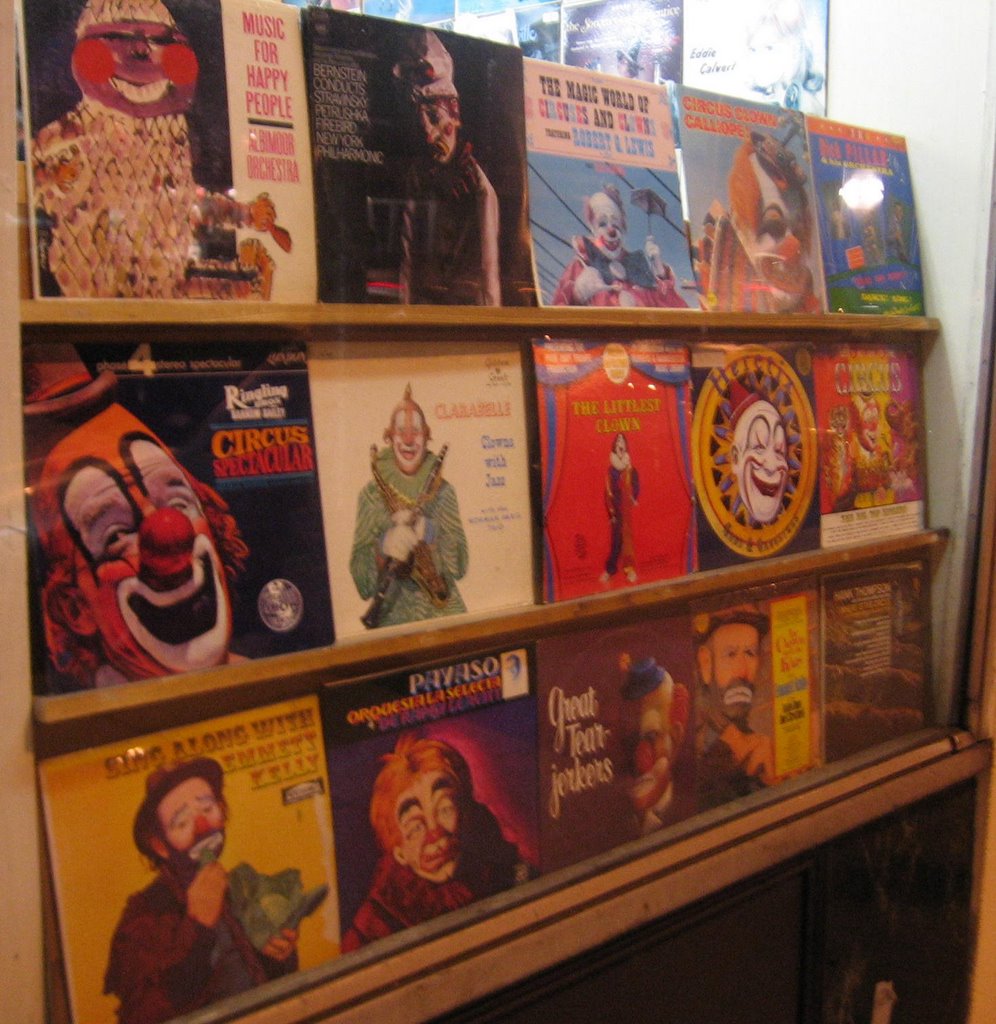
Stereo Jack's dug deep and came up with an inspired display of LPs featuring clowns on the covers. Guaranteed to inspire joy or fear, depending on your reaction to greasepainted, garishly dressed overactors with a penchant for tiny, tiny cars.
Maybe a Rental
The guy in this movie I saw last night used to be in that TV show a few years back. The one about the podiatrist in California who part-time manages a golf-ball salvage company near Pebble Beach? Remember that one? It was on for, like, three, four seasons. I liked him on that show, although I remember a lot of the other characters better. Still, he was pretty good in it. Now his hair’s all different, but he still mostly looks the same. You know the guy I’m talking about? The one on that show?
Anyway, in this movie he’s a small-time dealer of decorative cow skulls. For Southwestern decorating or whatever. He lives out in New Mexico and has this whole setup with a rendering plant to get cow skulls. Then he bleaches them and decorates them with turquoise and silver and paint. All the tourists go crazy for that stuff, so he has a nice little business and his life seems okay. But then this corporation wants to buy him out and mass-produce the skulls he makes. He’s got a lock on the business because of his deal with the rendering plant, so they want to take over the whole operation. The company wants to make the skulls faster and cheaper, and then sell them at these stores they have all over the highways, a chain of gas stations and restaurants called Hoof ’n’ Mouth.
The company sends out a PR specialist lawyer or something to sway his decision. It’s not totally clear what her credentials are, but she’s ridiculously pretty. That’s the love-interest angle. She’s played by the girl from that cheerleader movie. You know the one? It’s been a few years since that movie, and she looks older now, but it was still hard to believe this girl was a hotshot lawyer with a huge corporation. She looks more like she’s still hoping to pass her bar exams. But she was pretty good, I guess. Anyway, she comes to town and keeps trying to make appointments with the guy so she can convince him about the benefits of selling out. He keeps dodging her.
Oh, I should mention here that the company wants to just go over the guy’s head and make a deal directly with the rendering plant, but two of the main executives at the plant are the guy’s twin cousins. And they don’t like the Hoof ’n’ Mouth company, anyway, because years ago they were staying at one of its luxury hotels with their fiancees, who then ran off with members of a Latin jazz band playing at the hotel lounge. So they’re against doing any kind of deal, and every time the subject comes up, the twin cousins get all weepy about the women who ran out on them. It’s a pretty corny shtick.
Besides that, though, most of the story is made up of stilted conversations between the two main characters. It’s textbook romantic comedy stuff. You can sense right away that they’re both really attracted to each other, but they’re on opposite sides, so it’s all mixed messages and awkwardness. And they’re always trying to look like they’re not looking at each other, but of course they are. Averted eyes, stammering, shifting from foot to foot—the whole deal. But she’s very persistent. He keeps saying no, and she keeps finding new angles, coming around day after day with another offer. Finally after a week or something, she gets the guy to meet her at a local diner, and then they start the serious flirting.
You can tell that the woman knows she’s not going to get anywhere in the negotiations, so it’s funny after a while how she just keeps coming up with reasons to go visit him again and again. He always acts annoyed, of course, but he always stares after her just a little too long when gets into her rental car and drives off. Or he takes much longer than necessary with their banter before he insists on knowing what her visit’s about this time. So it’s easy to see that he likes the fact that she keeps showing up, even if he does get pretty sarcastic in some of the scenes.
But when they’re at the diner, the whole thing just comes together for them. She’s nervous, and she looks for a really long time at all the items on the menu, even though she later ends up ordering the first thing she mentioned she was in the mood for. But while she’s staring at the menu, the guy just stares at her like he’s lovesick. And then she looks up, directly into his eyes and raises her eyebrows very, very slightly. And he doesn’t look away for a couple of seconds until the waitress comes over and interrupts them. Both of them get nervous and start fumbling around, trying to place their orders like nothing just happened.
It seems like everything should fall into place then, but it’s just the beginning of the end. At least for the guy who has the skull-selling business. He and the lawyer fall in love and all, and the big romantic song from the movie, “Piece by Piece” (a horrible song title considering all the rendering plant scenes, really) plays over the tastefully filmed scene of them going back to her motel and going to bed together. (“Tastefully filmed” means you totally don’t see anything, so don’t get excited.)
Then the lawyer goes and has a meeting with her bosses at the local Hoof ’n’ Mouth. She makes this totally unworkable pitch that the company should give up buying the guy out and should somehow work with him instead. The bosses get mad, and she’s immediately sent back to the company’s headquarters in Atlanta. She’s upset but she has to go if she wants to keep her job. And then the big corporation somehow forces a board meeting at the rendering plant, and when some of the board members find out just how much money they can make by partnering with them, they sell out for all the animal parts they want. Then they all have this big barbecue to celebrate. It’s kind of hard to watch.
With everything he’s worked for now gone, the guy packs up a truck and heads out to Atlanta. The lawyer left without really telling him what was going on, but he finds out how she got transferred so quickly and goes after her. But when he gets there, he’s in for a surprise. She’s been involved with someone else all along. Part of the reason she left without more of a fight is that she thought it would be better for everyone. This gives the main character a chance to have a big, ranty speech in which he talks about how betrayed his heart has been. It’s also kind of hard to watch.
The last part of the movie is a kind of goofy chase as the guy hits the road, heading back out west in search of a brand new start. And then after half a day of soul-searching—a long montage of the lawyer being distressed and remembering all the great stuff about this new guy she loves while “Piece by Piece” plays again—she decides that she’ll go after him. She ditches her stable, fulfilling life, the handsome, sensitive guy she’s engaged to, and her financially secure future. She packs a bag and heads west to follow her impulsive, unemployed, former kitsch artisan of a lover.
They both drive and drive. It’s supposed to be funny and cute and romantic and just a little dramatically frustrating, but whether you swallow that or not, what basically happens is that they keep going to the same places at exactly the wrong time. Just after he pulls out of a convenience store, she walks out of the ladies room and goes inside to get some coffee. He stops at a roadside vendor to buy homemade tamales, and she zooms past to get to the next town. And since she ends up taking the last vacancy at the motel in town, he has to drive another hundred miles to find a place of his own. On and on like that, for countless scenes, all the way back to New Mexico, where the figures he can start a new business making Day of the Dead dioramas to sell in Santa Fe.
In the big, final scene, he ends us being the one to find her, rather than the other way around. He stops at this strip mall along the highway, and he gets into a conversation with a guy who works at a memorabilia store. Then out the window of the store he sees that the lawyer from Atlanta is in the same strip mall. She’s ordering lunch at a fast food burrito shack. He stops in the middle of his conversation and goes out the door.
This is where the film just chucks all pretense at believability and unexpectedly plays the art-house card. One guy in the theater found this so jarring that he started making a lot of comments about it right out loud. It’s a wonder he didn’t get kicked out, but that’s probably because a good portion of the audience agreed with him. What happens is, as soon as the guy leaves the store, there’s a jumble of confusing jump cuts and you end up following the rest of the action to four separate conclusions, none of which is obviously the right one. It’s not like a dream sequence or a wish sequence or anything. It just goes down one path, then another, then another, and finally another. But in all cases, the conclusion draws to the same scene, only with a different spin.
First the guy leaves the store, stands looking at her across the parking lot for a good long while, shakes his head sadly, and gets into his truck and drives on down the road. The woman never even sees him. She sits at one of the big round concrete tables alongside the burrito place and stares off down the highway in the opposite direction. She looks really sad, and you can tell she’s pretty much giving up now. Then the guy running the burrito stand calls out several times to get her attention. He tells her that her order is ready.
Then they jump back and the guy leaves the store, goes over to the burrito place, and waits for her to turn around and see him. When she does, she gasps and runs over to him. Neither of them says anything. They just hug for a long time, then sit down anxiously at the table. She tells him she’s been chasing him across six states. He tells her that if she’s tired of chasing him, he’s ready to stop now. They kiss. Then the guy running the burrito stand calls out several times to get her attention. He tells her that her order is ready.
Then they jump back again and the guy leaves the store, goes over to the burrito place, and waits for her to turn around and see him. When she does, she gasps, but she doesn’t run over to him. Because he looks really mad that she’s there, and she doesn’t know what to say. She tries to explain what happened and how now she’s come to her senses, but he doesn’t want to hear it. He’s still mad that she lied to him, and now this stunt has just made it all the more obvious to him that she’s a very unstable person. She risked her job, let her company order her around against her will, betrayed the man she had been with, then put her whole life on hold and went chasing after somebody she hardly knows. He doesn’t want to hear anything more from her. She looks really upset, and he goes to his truck and drives away. You get a chance to see just how really sad he is once he turns away from her, but that didn’t seem very redeeming after he just blasted this woman in public without even bothering to hear her out. The woman sits down at a table and starts crying. Then the guy running the burrito stand calls out several times to get her attention. He tells her that her order is ready.
Then they jump back one last time and guy leaves the store, stands watching her from a distance for a while, and then goes over to her. He taps her lightly on the shoulder. She turns and gasps, then waits for him to say something. He looks nervous, but finally asks her how the food is here. She laughs lightly and says it’s her first time to eat there, so she’s not sure. Then after a pause, she starts trying to apologize for everything in a rush. He gets her to calm down, and they sit at a table and begin to talk slowly and deliberately to one another, expressing themselves as best they can. It’s apparent that he’s apprehensive, but he wants to see if they can salvage something and go on from there. She agrees and takes his hand. Then the guy running the burrito stand calls out several times to get her attention. He tells her that her order is ready.
The screen goes black. Credits roll. Songs by people you’ve never heard of play over the credits. And they note in the credits that no animals were harmed in the making of the film, which is comforting given the large part rendering plants played in the movie. Plus all the cattle skulls. But, seriously, how’d they get their bones out without the cows coming to harm? Did anyone even bother to check on that? Maybe they’ll explain that some more on the DVD release, which is probably happening any second now.
Anyway, in this movie he’s a small-time dealer of decorative cow skulls. For Southwestern decorating or whatever. He lives out in New Mexico and has this whole setup with a rendering plant to get cow skulls. Then he bleaches them and decorates them with turquoise and silver and paint. All the tourists go crazy for that stuff, so he has a nice little business and his life seems okay. But then this corporation wants to buy him out and mass-produce the skulls he makes. He’s got a lock on the business because of his deal with the rendering plant, so they want to take over the whole operation. The company wants to make the skulls faster and cheaper, and then sell them at these stores they have all over the highways, a chain of gas stations and restaurants called Hoof ’n’ Mouth.
The company sends out a PR specialist lawyer or something to sway his decision. It’s not totally clear what her credentials are, but she’s ridiculously pretty. That’s the love-interest angle. She’s played by the girl from that cheerleader movie. You know the one? It’s been a few years since that movie, and she looks older now, but it was still hard to believe this girl was a hotshot lawyer with a huge corporation. She looks more like she’s still hoping to pass her bar exams. But she was pretty good, I guess. Anyway, she comes to town and keeps trying to make appointments with the guy so she can convince him about the benefits of selling out. He keeps dodging her.
Oh, I should mention here that the company wants to just go over the guy’s head and make a deal directly with the rendering plant, but two of the main executives at the plant are the guy’s twin cousins. And they don’t like the Hoof ’n’ Mouth company, anyway, because years ago they were staying at one of its luxury hotels with their fiancees, who then ran off with members of a Latin jazz band playing at the hotel lounge. So they’re against doing any kind of deal, and every time the subject comes up, the twin cousins get all weepy about the women who ran out on them. It’s a pretty corny shtick.
Besides that, though, most of the story is made up of stilted conversations between the two main characters. It’s textbook romantic comedy stuff. You can sense right away that they’re both really attracted to each other, but they’re on opposite sides, so it’s all mixed messages and awkwardness. And they’re always trying to look like they’re not looking at each other, but of course they are. Averted eyes, stammering, shifting from foot to foot—the whole deal. But she’s very persistent. He keeps saying no, and she keeps finding new angles, coming around day after day with another offer. Finally after a week or something, she gets the guy to meet her at a local diner, and then they start the serious flirting.
You can tell that the woman knows she’s not going to get anywhere in the negotiations, so it’s funny after a while how she just keeps coming up with reasons to go visit him again and again. He always acts annoyed, of course, but he always stares after her just a little too long when gets into her rental car and drives off. Or he takes much longer than necessary with their banter before he insists on knowing what her visit’s about this time. So it’s easy to see that he likes the fact that she keeps showing up, even if he does get pretty sarcastic in some of the scenes.
But when they’re at the diner, the whole thing just comes together for them. She’s nervous, and she looks for a really long time at all the items on the menu, even though she later ends up ordering the first thing she mentioned she was in the mood for. But while she’s staring at the menu, the guy just stares at her like he’s lovesick. And then she looks up, directly into his eyes and raises her eyebrows very, very slightly. And he doesn’t look away for a couple of seconds until the waitress comes over and interrupts them. Both of them get nervous and start fumbling around, trying to place their orders like nothing just happened.
It seems like everything should fall into place then, but it’s just the beginning of the end. At least for the guy who has the skull-selling business. He and the lawyer fall in love and all, and the big romantic song from the movie, “Piece by Piece” (a horrible song title considering all the rendering plant scenes, really) plays over the tastefully filmed scene of them going back to her motel and going to bed together. (“Tastefully filmed” means you totally don’t see anything, so don’t get excited.)
Then the lawyer goes and has a meeting with her bosses at the local Hoof ’n’ Mouth. She makes this totally unworkable pitch that the company should give up buying the guy out and should somehow work with him instead. The bosses get mad, and she’s immediately sent back to the company’s headquarters in Atlanta. She’s upset but she has to go if she wants to keep her job. And then the big corporation somehow forces a board meeting at the rendering plant, and when some of the board members find out just how much money they can make by partnering with them, they sell out for all the animal parts they want. Then they all have this big barbecue to celebrate. It’s kind of hard to watch.
With everything he’s worked for now gone, the guy packs up a truck and heads out to Atlanta. The lawyer left without really telling him what was going on, but he finds out how she got transferred so quickly and goes after her. But when he gets there, he’s in for a surprise. She’s been involved with someone else all along. Part of the reason she left without more of a fight is that she thought it would be better for everyone. This gives the main character a chance to have a big, ranty speech in which he talks about how betrayed his heart has been. It’s also kind of hard to watch.
The last part of the movie is a kind of goofy chase as the guy hits the road, heading back out west in search of a brand new start. And then after half a day of soul-searching—a long montage of the lawyer being distressed and remembering all the great stuff about this new guy she loves while “Piece by Piece” plays again—she decides that she’ll go after him. She ditches her stable, fulfilling life, the handsome, sensitive guy she’s engaged to, and her financially secure future. She packs a bag and heads west to follow her impulsive, unemployed, former kitsch artisan of a lover.
They both drive and drive. It’s supposed to be funny and cute and romantic and just a little dramatically frustrating, but whether you swallow that or not, what basically happens is that they keep going to the same places at exactly the wrong time. Just after he pulls out of a convenience store, she walks out of the ladies room and goes inside to get some coffee. He stops at a roadside vendor to buy homemade tamales, and she zooms past to get to the next town. And since she ends up taking the last vacancy at the motel in town, he has to drive another hundred miles to find a place of his own. On and on like that, for countless scenes, all the way back to New Mexico, where the figures he can start a new business making Day of the Dead dioramas to sell in Santa Fe.
In the big, final scene, he ends us being the one to find her, rather than the other way around. He stops at this strip mall along the highway, and he gets into a conversation with a guy who works at a memorabilia store. Then out the window of the store he sees that the lawyer from Atlanta is in the same strip mall. She’s ordering lunch at a fast food burrito shack. He stops in the middle of his conversation and goes out the door.
This is where the film just chucks all pretense at believability and unexpectedly plays the art-house card. One guy in the theater found this so jarring that he started making a lot of comments about it right out loud. It’s a wonder he didn’t get kicked out, but that’s probably because a good portion of the audience agreed with him. What happens is, as soon as the guy leaves the store, there’s a jumble of confusing jump cuts and you end up following the rest of the action to four separate conclusions, none of which is obviously the right one. It’s not like a dream sequence or a wish sequence or anything. It just goes down one path, then another, then another, and finally another. But in all cases, the conclusion draws to the same scene, only with a different spin.
First the guy leaves the store, stands looking at her across the parking lot for a good long while, shakes his head sadly, and gets into his truck and drives on down the road. The woman never even sees him. She sits at one of the big round concrete tables alongside the burrito place and stares off down the highway in the opposite direction. She looks really sad, and you can tell she’s pretty much giving up now. Then the guy running the burrito stand calls out several times to get her attention. He tells her that her order is ready.
Then they jump back and the guy leaves the store, goes over to the burrito place, and waits for her to turn around and see him. When she does, she gasps and runs over to him. Neither of them says anything. They just hug for a long time, then sit down anxiously at the table. She tells him she’s been chasing him across six states. He tells her that if she’s tired of chasing him, he’s ready to stop now. They kiss. Then the guy running the burrito stand calls out several times to get her attention. He tells her that her order is ready.
Then they jump back again and the guy leaves the store, goes over to the burrito place, and waits for her to turn around and see him. When she does, she gasps, but she doesn’t run over to him. Because he looks really mad that she’s there, and she doesn’t know what to say. She tries to explain what happened and how now she’s come to her senses, but he doesn’t want to hear it. He’s still mad that she lied to him, and now this stunt has just made it all the more obvious to him that she’s a very unstable person. She risked her job, let her company order her around against her will, betrayed the man she had been with, then put her whole life on hold and went chasing after somebody she hardly knows. He doesn’t want to hear anything more from her. She looks really upset, and he goes to his truck and drives away. You get a chance to see just how really sad he is once he turns away from her, but that didn’t seem very redeeming after he just blasted this woman in public without even bothering to hear her out. The woman sits down at a table and starts crying. Then the guy running the burrito stand calls out several times to get her attention. He tells her that her order is ready.
Then they jump back one last time and guy leaves the store, stands watching her from a distance for a while, and then goes over to her. He taps her lightly on the shoulder. She turns and gasps, then waits for him to say something. He looks nervous, but finally asks her how the food is here. She laughs lightly and says it’s her first time to eat there, so she’s not sure. Then after a pause, she starts trying to apologize for everything in a rush. He gets her to calm down, and they sit at a table and begin to talk slowly and deliberately to one another, expressing themselves as best they can. It’s apparent that he’s apprehensive, but he wants to see if they can salvage something and go on from there. She agrees and takes his hand. Then the guy running the burrito stand calls out several times to get her attention. He tells her that her order is ready.
The screen goes black. Credits roll. Songs by people you’ve never heard of play over the credits. And they note in the credits that no animals were harmed in the making of the film, which is comforting given the large part rendering plants played in the movie. Plus all the cattle skulls. But, seriously, how’d they get their bones out without the cows coming to harm? Did anyone even bother to check on that? Maybe they’ll explain that some more on the DVD release, which is probably happening any second now.
Monday, January 02, 2006
Today's Alphabet of Offenses
- Air Guitar Playing
- Boxing Kangaroos
- Censorship
- Discussing Deconstruction
- Encouraging Mediocrity
- Fluttering Your Eyelashes and Meaning It
- Guffawing
- Hierarchical Thinking
- Irksomeness
- Jingling Your Keys
- Kleptomania
- Legerdemain
- Monopolizing the Conversation
- Name Dropping
- Ogling
- Pretending Not to See Someone Who, Come On, You Can Obviously See
- Quantifying Your Emotions
- Reengineering Corporations
- Sulking
- Training Animals to Talk
- Ululating
- Vapidness
- Wanking (just kidding! seeing if you’re paying attention!)
- Xeroxing Your Butt
- Yielding to Authority
- Zaniness
Friday, December 30, 2005
"a very nice holidays"
“I think it’s weird that he sent us a card,” Pancakes told Pastina as they sat in the school cafeteria prior to rehearsals. The school’s winter show was scheduled for just before their holiday vacation, only two weeks away.
“There’s nothing weird about Christmas cards,” Pastina replied.
“But my family doesn’t even know Vincent. Why’s he sending cards to us? How many fourth graders send Christmas cards?”
“I do,” Pastina said.
“You’re not normal, though,” Pancakes said.
“True,” Pastina said. “I hang out with you.”
“Don’t be like that,” Pancakes said. “You’re an excellent Pastina. But Vincent’s a boy. He’s quiet and weird. He’s not a card-sender.”
Pastina shrugged. “Or maybe he is. He sent a card.”
When the oversized envelope had arrived at her house, Pancakes stood staring at it for several seconds. She opened it and found a large, almost-tasteful Christmas card. The script writing outside read “A Joyous Holiday!” and featured an ornate Victorian winter scene. Inside it read, “Wishing you and yours a very Merry Christmas and a Happy New Year.”
“I guess he just assumed we weren’t Jewish,” Pancakes told Pastina later that evening on the phone. Pastina thought about her friend’s shining blond hair and huge blue eyes and said, “Maybe somebody told him.”
Underneath the card’s printed greeting, Vincent had written in loose, uneven cursive letters, “I hope you and your family have a very nice holidays.” But the “a” had been scribbled out in an editorial afterthought. He had signed it, “Best wishes, Vincent Marr”. Pancakes couldn’t at first think of who that was, because she always forgot Vincent’s last name. “Friend of yours?” her father had asked as she stood in the living room and frowned at the card. “Or, um, an enemy?”
She shook her head. “Oh, it’s just Vincent. I think he has a crush on Pastina.”
“So I guess he sent her family an even better card?” Emiliano asked. Pancakes could tell he was using his ironic, bemused voice. She made a face at him and handed him the card. Then she went to call Pastina.
Pastina, it turned out, hadn’t received a card, but she pretended not to mind. “I don’t care. He’s your secret boyfriend,” she said.
“Oh, he is not!” Pancakes shouted. “He’s yours. He looooves you.”
“Yeah, well, he didn’t send a card to my house, did he? He’s trying to impress his future in-laws. Mrs. Vincent.”
Pancakes acted outraged by the entire incident, and she didn’t stop mentioning it for days after receiving the card. “Of course, now my mom will want to send him a card,” she said, although Pastina didn’t see why that would be. Lorinda didn’t even know about the card until Pancakes brought it up repeatedly, asking her parents on multiple occasions if it was absolutely necessary to send a card in return. They assured her that it didn’t have to work that way, but that didn’t stop her questions. So finally Emiliano retrieved a spare card, dashed a quick note of greeting inside, and passed it in front of both Lorinda and Pancakes for their individual signatures. Pancakes later explained to Pastina that her father practically forced her to send a card to Vincent just to be nice.
Pastina had quickly gotten bored of the subject, but Pancakes kept reviving the great card debate at least once a day. She insisted that Vincent didn’t really like her, pointing out that he’d eventually given a card to Pastina too. Of course, she ignored the fact that Pastina’s had been a small card stuffed into her locker, not like the large, expensive one he mailed to Pancakes at home. Pancakes continued to protest and rationalize the situation, but that just ensured that no one forgot about it.
“When we get to your house,” Pastina said at last as the two of them waited to be called to join in the winter song chorus, “we should find out once and for all about Vincent.”
“How?”
“Get the Ouija board out,” Pastina said. “It knows everything.” She nodded seriously.
Pancakes looked unsure. “I don’t know if that’s a good idea. That thing is weird. Plus, it might lie.”
“Why would it lie?” Pastina asked. “It’s a board. What’s it got to lie about?”
“I don’t know!” Pancakes whispered loudly. “It has its boardy reasons. I don’t trust it.”
Pancakes’s objections made no sense. The Ouija board, as far as Pastina knew, was eerily accurate. Pancakes had said so herself. Sometimes its answers didn’t make sense, but when they did, they were usually right. Just a month earlier, it had led them to buried treasure in Pancakes’s back yard.
“After the pirate treasure, you don’t trust it?” Pastina asked. “It told us exactly where to dig!”
Pancakes waved her arm dismissively. “That wasn’t real treasure,” she said. “That was just a bunch of junk from a birthday party.”
“A pirate birthday party,” Pastina said. “You said they buried that back when you had your pirate birthday party. I didn’t even know you then. And then we just find it all of sudden because the board said so.”
“But it was junk!” Pancakes said.
A nearby teacher shushed her loudly. “If you girls want to sing in the show, you’re going to need to keep it down,” she said.
Pancakes rolled her eyes for Pastina’s benefit. “Yeah,” she whispered, “that makes a lot of sense. ‘Be quiet if you want to sing.’”
Pastina smiled, but she made sure not to be obvious about it. She didn’t want to get in trouble, even if Pancakes didn’t seem to mind it.
“So you want to do the Ouija board later, then?” Pancakes asked. “We can if you want to.”
Pastina nodded.
“Fine, but it’s just going to tell you that Vincent’s a weirdo, plain and simple,” Pancakes said, and then they heard the teacher calling out their names. Pastina flinched. She was sure they were in trouble now. But it turned out it was their turn to join the chorus for “Winter Wonderland.” They opened their mouths and sang.
“There’s nothing weird about Christmas cards,” Pastina replied.
“But my family doesn’t even know Vincent. Why’s he sending cards to us? How many fourth graders send Christmas cards?”
“I do,” Pastina said.
“You’re not normal, though,” Pancakes said.
“True,” Pastina said. “I hang out with you.”
“Don’t be like that,” Pancakes said. “You’re an excellent Pastina. But Vincent’s a boy. He’s quiet and weird. He’s not a card-sender.”
Pastina shrugged. “Or maybe he is. He sent a card.”
When the oversized envelope had arrived at her house, Pancakes stood staring at it for several seconds. She opened it and found a large, almost-tasteful Christmas card. The script writing outside read “A Joyous Holiday!” and featured an ornate Victorian winter scene. Inside it read, “Wishing you and yours a very Merry Christmas and a Happy New Year.”
“I guess he just assumed we weren’t Jewish,” Pancakes told Pastina later that evening on the phone. Pastina thought about her friend’s shining blond hair and huge blue eyes and said, “Maybe somebody told him.”
Underneath the card’s printed greeting, Vincent had written in loose, uneven cursive letters, “I hope you and your family have a very nice holidays.” But the “a” had been scribbled out in an editorial afterthought. He had signed it, “Best wishes, Vincent Marr”. Pancakes couldn’t at first think of who that was, because she always forgot Vincent’s last name. “Friend of yours?” her father had asked as she stood in the living room and frowned at the card. “Or, um, an enemy?”
She shook her head. “Oh, it’s just Vincent. I think he has a crush on Pastina.”
“So I guess he sent her family an even better card?” Emiliano asked. Pancakes could tell he was using his ironic, bemused voice. She made a face at him and handed him the card. Then she went to call Pastina.
Pastina, it turned out, hadn’t received a card, but she pretended not to mind. “I don’t care. He’s your secret boyfriend,” she said.
“Oh, he is not!” Pancakes shouted. “He’s yours. He looooves you.”
“Yeah, well, he didn’t send a card to my house, did he? He’s trying to impress his future in-laws. Mrs. Vincent.”
Pancakes acted outraged by the entire incident, and she didn’t stop mentioning it for days after receiving the card. “Of course, now my mom will want to send him a card,” she said, although Pastina didn’t see why that would be. Lorinda didn’t even know about the card until Pancakes brought it up repeatedly, asking her parents on multiple occasions if it was absolutely necessary to send a card in return. They assured her that it didn’t have to work that way, but that didn’t stop her questions. So finally Emiliano retrieved a spare card, dashed a quick note of greeting inside, and passed it in front of both Lorinda and Pancakes for their individual signatures. Pancakes later explained to Pastina that her father practically forced her to send a card to Vincent just to be nice.
Pastina had quickly gotten bored of the subject, but Pancakes kept reviving the great card debate at least once a day. She insisted that Vincent didn’t really like her, pointing out that he’d eventually given a card to Pastina too. Of course, she ignored the fact that Pastina’s had been a small card stuffed into her locker, not like the large, expensive one he mailed to Pancakes at home. Pancakes continued to protest and rationalize the situation, but that just ensured that no one forgot about it.
“When we get to your house,” Pastina said at last as the two of them waited to be called to join in the winter song chorus, “we should find out once and for all about Vincent.”
“How?”
“Get the Ouija board out,” Pastina said. “It knows everything.” She nodded seriously.
Pancakes looked unsure. “I don’t know if that’s a good idea. That thing is weird. Plus, it might lie.”
“Why would it lie?” Pastina asked. “It’s a board. What’s it got to lie about?”
“I don’t know!” Pancakes whispered loudly. “It has its boardy reasons. I don’t trust it.”
Pancakes’s objections made no sense. The Ouija board, as far as Pastina knew, was eerily accurate. Pancakes had said so herself. Sometimes its answers didn’t make sense, but when they did, they were usually right. Just a month earlier, it had led them to buried treasure in Pancakes’s back yard.
“After the pirate treasure, you don’t trust it?” Pastina asked. “It told us exactly where to dig!”
Pancakes waved her arm dismissively. “That wasn’t real treasure,” she said. “That was just a bunch of junk from a birthday party.”
“A pirate birthday party,” Pastina said. “You said they buried that back when you had your pirate birthday party. I didn’t even know you then. And then we just find it all of sudden because the board said so.”
“But it was junk!” Pancakes said.
A nearby teacher shushed her loudly. “If you girls want to sing in the show, you’re going to need to keep it down,” she said.
Pancakes rolled her eyes for Pastina’s benefit. “Yeah,” she whispered, “that makes a lot of sense. ‘Be quiet if you want to sing.’”
Pastina smiled, but she made sure not to be obvious about it. She didn’t want to get in trouble, even if Pancakes didn’t seem to mind it.
“So you want to do the Ouija board later, then?” Pancakes asked. “We can if you want to.”
Pastina nodded.
“Fine, but it’s just going to tell you that Vincent’s a weirdo, plain and simple,” Pancakes said, and then they heard the teacher calling out their names. Pastina flinched. She was sure they were in trouble now. But it turned out it was their turn to join the chorus for “Winter Wonderland.” They opened their mouths and sang.
Sunday, December 18, 2005
strategies for success!
When Pastina found Irene, who had been acting as assistant director on their student film, the high-strung young woman was crying. Not just a few tears of frustration. She was ready for a thick handful of tissues, a liberal dose of eyedrops, maybe even a touch of anti-inflammatory cream for the red puffiness around her eyes. Immediately, Pastina knew what the problem was.
“What is it?” she asked softly, touching Irene’s shoulder. “What did Pancakes say to you?”
Irene tried to get her mild hyperventilation under control. She spoke between sniffles. “She said I had … I had … all the organizational skill … of the Italian postal service.” Irene buried her face in her hands.
Pastina sighed and patted Irene on the arm. “She gets like that sometimes,” she said. “Look, I’m sure you were doing your best. Let’s just show her how good you are. Do you have those call sheets ready for tomorrow?”
“I’ve been too upset.”
Pastina drew back and shook her head. “Well, if you can get that done real quick, then Pancakes won’t have to know anything about it. What do you think?”
Irene smiled a little, then a lot. She nodded and stood. “You’re right. Thanks, Pastina. I’ll have those ready in a little while. Maybe I should come over and give them to you when Pancakes is there.”
“Good thinking!” Pastina said in her best motivational voice.
Irene dashed off to compose schedules for their next shoot. Pastina watched her go with relief. That had been the easiest one yet. Over the past few hours, Pancakes had made five different people cry or work themselves into hysterical states over her harsh criticism. Each time, Pastina had moved in her wake to pick up the pieces and set the person back on track. All in all, Pastina thought their system was all working beautifully.
“We should have done that weeks ago,” Pastina told Pancakes later that evening when they were driving back from location.
“Years,” Pancakes said, her eyes on the road, an sly grin on her face.
“Oh, yeah, years,” Pastina agreed. “It was so great. You broke ‘em down, and I built ‘em up!”
“The classic strategies are the best,” Pancakes said. “There’s a reason they use them even when everybody knows the game.”
“I wonder if anybody else knows about this 'good director/bad director' thing.”
Pancakes made a mock gun of her right hand and pretended to fire into the distance. “Works every time.”
“What is it?” she asked softly, touching Irene’s shoulder. “What did Pancakes say to you?”
Irene tried to get her mild hyperventilation under control. She spoke between sniffles. “She said I had … I had … all the organizational skill … of the Italian postal service.” Irene buried her face in her hands.
Pastina sighed and patted Irene on the arm. “She gets like that sometimes,” she said. “Look, I’m sure you were doing your best. Let’s just show her how good you are. Do you have those call sheets ready for tomorrow?”
“I’ve been too upset.”
Pastina drew back and shook her head. “Well, if you can get that done real quick, then Pancakes won’t have to know anything about it. What do you think?”
Irene smiled a little, then a lot. She nodded and stood. “You’re right. Thanks, Pastina. I’ll have those ready in a little while. Maybe I should come over and give them to you when Pancakes is there.”
“Good thinking!” Pastina said in her best motivational voice.
Irene dashed off to compose schedules for their next shoot. Pastina watched her go with relief. That had been the easiest one yet. Over the past few hours, Pancakes had made five different people cry or work themselves into hysterical states over her harsh criticism. Each time, Pastina had moved in her wake to pick up the pieces and set the person back on track. All in all, Pastina thought their system was all working beautifully.
“We should have done that weeks ago,” Pastina told Pancakes later that evening when they were driving back from location.
“Years,” Pancakes said, her eyes on the road, an sly grin on her face.
“Oh, yeah, years,” Pastina agreed. “It was so great. You broke ‘em down, and I built ‘em up!”
“The classic strategies are the best,” Pancakes said. “There’s a reason they use them even when everybody knows the game.”
“I wonder if anybody else knows about this 'good director/bad director' thing.”
Pancakes made a mock gun of her right hand and pretended to fire into the distance. “Works every time.”
Friday, December 16, 2005
Collaborative
INT. DAY — Me’s Dining Room
Me and Her sit at opposite ends of a long wooden table. Each of them has a pile of papers before her. As they talk, they make notes or refer to various pieces of paper.
ME: Are you ever going to say anything?
HER: What am I supposed to say? There’s nothing here I can respond to in a constructive way.
ME: We have to come up with a compromise. I don’t like this any more than you do.
HER: I’m not so sure about that. I think you might. I mean, look at this. You’ve added a whole song here that we never even discussed. How could you write another song and not tell me?
ME: You don’t like it? I thought we needed to explain why the judge was sentencing the young mother to a gulag for hoarding bread. The text didn’t really explore that.
HER: Whether I like it or not isn't the point. You keep adding this stuff without consulting me. Then all you do later is justify it. You’re shutting me out!
ME: Oh, fine. But you can rewrite almost a whole act? You can revise the whole costume concept so that we have to hold a bake sale to pay for all the extra silver lamé?
HER: I told you about the rewrite. You just weren’t listening. And the costume stuff. I didn’t go sneaking in new stuff and then try to act like it made the whole thing better. Do you just want to write this yourself?
ME: No.
HER: Well, then start working with me.
ME: Why do you think we’re sitting here? We’re supposed to be working. Come on. Let’s do it. You and me. Right now. Come on. We can work it out.
HER: What are you doing? Is this you cheerleading?
ME: Come on.
HER: Um, okay.
ME: We’re going to have a theater full of people.
HER: I know.
ME: All of our classmates will be there.
HER: Yeah, I know.
ME: Your mom is going to be there. My mom.
HER: I’ve thought about this.
ME: So we have to have something to put on that stage. We have to present something, or else everybody’s going to laugh at us.
HER: I agree. But you're going to have to start playing straight or this isn’t going to work.
ME: Okay, fine. I’ve been playing straight, but whatever. I’ll meet you halfway, if that’s what you need.
HER: Call it whatever you want. Just don’t try to squeeze in any more material that we haven’t agreed on.
ME: I would never do that.
HER: No, I’m sure.
ME: So maybe we can run down the song list. You want to start with that?
HER: Okay, I guess we can do that. It's a start.
ME: Good. See? We’re working. Right. So skip the overture and stuff … blah blah blah … first thing up is “It’s a Fine Old Mornin’ for Mass Oppression.”
HER: What about the orphan song?
ME: “Giving Kids the Business”? We moved that to the second act, remember?
HER: Oh, right. Go ahead. What’s next?
ME: Then it’s “The Philanderer’s Song.”
HER: The school board will love it. And after that?
ME: Then it’s the first really big song: “Grains of Hope.” That’s when the woman steals the bread and marmalade.
HER: That’s not that big a song. It’s a plot point song.
ME: But it’s a big plot point.
HER: It doesn’t matter. The big songs don’t have to be the ones that are most important to the plot. The big songs are the ones that become hits.
ME: We’re not writing a Broadway show here. Can we focus? It’s just a majorly important song. That’s all I’m saying.
HER: It just sounded like you were ranking it. Sorry. I wasn’t trying to get off the point.
ME: Okay. So next we move on to “Working Girls Like Pretty Dresses, Too.”
HER: Which is technically the first big song.
ME: Let it go.
HER: I said I let it go. I’m just saying. There’s dancing and stuff with that one.
ME: Fine. Shuffle, shuffle, shuffle. Then off go the prostitutes.
HER: (enthusiastically) One of whom’s the illegitimate daughter of the factory owner!
ME: (pause) Yeah … I still don’t like that.
HER: What? Wait a minute. We’ve been over that a million times.
ME: And wouldn’t you think it’d feel right by now? But it doesn’t. It makes the whole show about heredity and destiny. It undercuts any kind of serious socialistic reading.
HER: Oh, come on. This is supposed to be a musical revue and some skits. We’ve gotten kind of ambitious, but it’s still a school play. Forget about the critics. Other than the school paper, who's going to reveiw this? You're just slowing down the process again!
ME: I’m just telling you what I think. Why are you getting so hostile?
HER: Hello? Have you ever had to work with you?
Me gets up from her chair and walks calmly to the camera. The screen goes dark. A title card appears, reading:
LATER THAT SAME DAY
Me and Her still sit at opposite sides of the same table. They each sit very still, staring at one another. They have their hands folded neatly in front of them. Neither of them blinks for several seconds. Ambient sounds come from other parts of the house.
ME: You’re going to lose. You might as well save yourself the eye strain.
HER: You think you’re so smart. You are, but I still might be able to win this yet.
ME: You’re only saying that because you blinked just then.
HER: (blinking angrily) What? I did not!
ME: No, but you did just then.
HER: You’re a cheat!
ME: And you’re a girl who can’t win a staring contest. Just accept your fate.
Her shoves back her chair and stomps over to the camera. The screen goes dark. A title card appears, reading:
AND EVEN LATER THAT SAME DAY
Me and Her still sit at opposite sides of the same table. Once again they’re shuffling papers and chatting about their collaboration.
HER: The matter of the backstory on the prostitute is now on the official Compromise Committee agenda. Let’s go on with the songs, if that’s okay with you.
ME: That’s okay with me if it’s okay with you.
HER: It’s okay with me.
ME: Then, okay. That’s actually all of act one.
HER: No, there’s one more. The solo by the blind government functionary.
ME: Did we ever come up with a title?
HER: We were just calling it the “I See” song.
ME: We didn’t cut that?
HER: Well, no. That one’s very important for the whole show. You liked it, remember?
ME: Oh, wait! That’s the one that goes, “I see no industrial waste / I see no corruption and greed”?
HER: “I see no fault indeed with the present regime / For at least I have all that I need.”
ME: Right! Man, I love that!
HER: Yeah, I know. You wrote most of it.
ME: Oh, right. So that’s all of act one?
HER: Blessedly, yes. Only two more to go.
Me and Her sit at opposite ends of a long wooden table. Each of them has a pile of papers before her. As they talk, they make notes or refer to various pieces of paper.
ME: Are you ever going to say anything?
HER: What am I supposed to say? There’s nothing here I can respond to in a constructive way.
ME: We have to come up with a compromise. I don’t like this any more than you do.
HER: I’m not so sure about that. I think you might. I mean, look at this. You’ve added a whole song here that we never even discussed. How could you write another song and not tell me?
ME: You don’t like it? I thought we needed to explain why the judge was sentencing the young mother to a gulag for hoarding bread. The text didn’t really explore that.
HER: Whether I like it or not isn't the point. You keep adding this stuff without consulting me. Then all you do later is justify it. You’re shutting me out!
ME: Oh, fine. But you can rewrite almost a whole act? You can revise the whole costume concept so that we have to hold a bake sale to pay for all the extra silver lamé?
HER: I told you about the rewrite. You just weren’t listening. And the costume stuff. I didn’t go sneaking in new stuff and then try to act like it made the whole thing better. Do you just want to write this yourself?
ME: No.
HER: Well, then start working with me.
ME: Why do you think we’re sitting here? We’re supposed to be working. Come on. Let’s do it. You and me. Right now. Come on. We can work it out.
HER: What are you doing? Is this you cheerleading?
ME: Come on.
HER: Um, okay.
ME: We’re going to have a theater full of people.
HER: I know.
ME: All of our classmates will be there.
HER: Yeah, I know.
ME: Your mom is going to be there. My mom.
HER: I’ve thought about this.
ME: So we have to have something to put on that stage. We have to present something, or else everybody’s going to laugh at us.
HER: I agree. But you're going to have to start playing straight or this isn’t going to work.
ME: Okay, fine. I’ve been playing straight, but whatever. I’ll meet you halfway, if that’s what you need.
HER: Call it whatever you want. Just don’t try to squeeze in any more material that we haven’t agreed on.
ME: I would never do that.
HER: No, I’m sure.
ME: So maybe we can run down the song list. You want to start with that?
HER: Okay, I guess we can do that. It's a start.
ME: Good. See? We’re working. Right. So skip the overture and stuff … blah blah blah … first thing up is “It’s a Fine Old Mornin’ for Mass Oppression.”
HER: What about the orphan song?
ME: “Giving Kids the Business”? We moved that to the second act, remember?
HER: Oh, right. Go ahead. What’s next?
ME: Then it’s “The Philanderer’s Song.”
HER: The school board will love it. And after that?
ME: Then it’s the first really big song: “Grains of Hope.” That’s when the woman steals the bread and marmalade.
HER: That’s not that big a song. It’s a plot point song.
ME: But it’s a big plot point.
HER: It doesn’t matter. The big songs don’t have to be the ones that are most important to the plot. The big songs are the ones that become hits.
ME: We’re not writing a Broadway show here. Can we focus? It’s just a majorly important song. That’s all I’m saying.
HER: It just sounded like you were ranking it. Sorry. I wasn’t trying to get off the point.
ME: Okay. So next we move on to “Working Girls Like Pretty Dresses, Too.”
HER: Which is technically the first big song.
ME: Let it go.
HER: I said I let it go. I’m just saying. There’s dancing and stuff with that one.
ME: Fine. Shuffle, shuffle, shuffle. Then off go the prostitutes.
HER: (enthusiastically) One of whom’s the illegitimate daughter of the factory owner!
ME: (pause) Yeah … I still don’t like that.
HER: What? Wait a minute. We’ve been over that a million times.
ME: And wouldn’t you think it’d feel right by now? But it doesn’t. It makes the whole show about heredity and destiny. It undercuts any kind of serious socialistic reading.
HER: Oh, come on. This is supposed to be a musical revue and some skits. We’ve gotten kind of ambitious, but it’s still a school play. Forget about the critics. Other than the school paper, who's going to reveiw this? You're just slowing down the process again!
ME: I’m just telling you what I think. Why are you getting so hostile?
HER: Hello? Have you ever had to work with you?
Me gets up from her chair and walks calmly to the camera. The screen goes dark. A title card appears, reading:
LATER THAT SAME DAY
Me and Her still sit at opposite sides of the same table. They each sit very still, staring at one another. They have their hands folded neatly in front of them. Neither of them blinks for several seconds. Ambient sounds come from other parts of the house.
ME: You’re going to lose. You might as well save yourself the eye strain.
HER: You think you’re so smart. You are, but I still might be able to win this yet.
ME: You’re only saying that because you blinked just then.
HER: (blinking angrily) What? I did not!
ME: No, but you did just then.
HER: You’re a cheat!
ME: And you’re a girl who can’t win a staring contest. Just accept your fate.
Her shoves back her chair and stomps over to the camera. The screen goes dark. A title card appears, reading:
AND EVEN LATER THAT SAME DAY
Me and Her still sit at opposite sides of the same table. Once again they’re shuffling papers and chatting about their collaboration.
HER: The matter of the backstory on the prostitute is now on the official Compromise Committee agenda. Let’s go on with the songs, if that’s okay with you.
ME: That’s okay with me if it’s okay with you.
HER: It’s okay with me.
ME: Then, okay. That’s actually all of act one.
HER: No, there’s one more. The solo by the blind government functionary.
ME: Did we ever come up with a title?
HER: We were just calling it the “I See” song.
ME: We didn’t cut that?
HER: Well, no. That one’s very important for the whole show. You liked it, remember?
ME: Oh, wait! That’s the one that goes, “I see no industrial waste / I see no corruption and greed”?
HER: “I see no fault indeed with the present regime / For at least I have all that I need.”
ME: Right! Man, I love that!
HER: Yeah, I know. You wrote most of it.
ME: Oh, right. So that’s all of act one?
HER: Blessedly, yes. Only two more to go.
Monday, December 12, 2005
The Most Brilliant Performer in the Whole First Grade
Mrs. Fletcher tried to coax the class to be quiet, but they were beyond all control. Ramon sat up on the makeshift stage in the school library, holding the decorative paper skeleton at arm’s length. He argued with the thing, then shook it violently as he pretended it responded to him. It hardly mattered what they were arguing about, and Ramon knew that. He just said, “No, no. You can’t. You can’t do it! Stop asking me!” And then he shook the skeleton and gave it voice, a high, screechy voice that said nothing intelligible. It sounded like, “Nyih-nyih-nyih! Nyih-nyih-nyih-nyih!” And every time it did so, the assembled group of sixty children erupted in peals of laughter. As far as they were concerned, Ramon was the funniest person alive.
“This doesn’t make sense,” Pancakes Dunst said to Meredith. But Meredith didn’t hear her. She was laughing too much. Up on the stage, Ramon and the skeleton continued arguing, escalating in volume and intensity. For everyone other than Pancakes and Mrs. Fletcher, the moment was pure, undistilled comedy, the very essence of humor. Ramon had gone to the root of all that is funny and presented it to his classmates for their grateful benefit. If Meredith hadn’t been snorting with uncontrollable mirth, she might have offered her opinion that Ramon was, frankly, a genius. The skeleton thing absolutely killed.
Just when the kids were getting used to the idea of Ramon’s arguing with a paper skeleton and began to quiet a bit, he changed up the act. He leapt to his feet, the skeleton outstretched before him in his left hand, and delivered a punch to its grinning skull with his right fist. “Nyih-ihh!” he screeched as the skeleton’s response. The children launched into fresh gales of laughter. He punched it again. The skeleton quivered with rage.
“This is nonsense!” Pancakes said, louder this time. She had a hard time making herself heard over the raucous appreciation of her classmates. She appealed to her teacher. “Mrs. Fletcher, why is this funny to everybody? It’s just stupid.”
The thirty-year-old Mrs. Fletcher, who most of children considered on the verge of her twilight years, looked down to where Pancakes sat on the fuzzy orange carpet. She adjusted her glasses nervously. Talking to Pancakes always made her a little nervous. The girl was so serious sometimes. She was too direct for a seven-year-old. “It doesn’t really appeal to me,” Mrs. Fletcher said. “But a lot of children love slapstick humor.”
“But…” Pancakes began. She faltered, searching for the words to explain what was confounding her. “But there’s no…there’s no, um…there’s no context,” she said. “You know what I mean?”
Mrs. Fletcher sighed inwardly. She taught first grade for many reasons, one which was that her students didn’t tend to engage in debates. She didn’t do well with debates, and she preferred to issue simple instructions and make behavior corrections. She didn’t want to talk about why certain kinds of humor needed context. “Pancakes,” she said, “it’s just a comedy act Ramon came up with. I don’t think he really wanted to give us any kind of message.”
On stage, Ramon had taken to trading blows with the skeleton. Its shaking rage had prompted it to attack him, which he indicated by fluttering the thing in his own face even as he shrank back from it. All the while, he continued to screech the skeleton’s annoyance. The kids couldn’t get enough.
Pancakes frowned. “But it’s a skeleton,” she said. “He’s arguing with it. My dad would say it was…Berman Ex.”
Mrs. Fletcher shook her head. “I don’t understand,” she said. “Berman?”
“It’s from the movies. Ingrid Berman?”
Mrs. Fletcher smiled in spite of herself. Pancakes thankfully revealed herself as a child at times. It made her teacher feel more in control of the situation. “I see. Bergmanesque. You’re thinking of Ingmar Bergman, Pancakes.”
“I thought her name was Ingrid. She’s been in a bunch of movies. My mother tries to look like her.”
“There is an Ingrid Bergman. She was a movie actress. But Ingmar Bergman, he was a movie director. Different person.”
“Well, whoever Bergman was, that’s like this.”
Before Mrs. Fletcher could respond, the kids burst out in a boisterous shout of hilarity. Ramon’s fight with his paper nemesis had gone from simple blows to desperate wrestling. The skeleton seemed to bowl him over, and Ramon fell to the floor. Then he tossed the skeleton away and made a comic lunge for it. Back and forth they went, pouncing on one another and rolling around the floor in simulated combat. Both Pancakes and Mrs. Fletcher looked on in terrified fascination as the volume level on the room went from an undulating roar to an outright explosion of amused screams.
Ramon appeared to have no plan for stopping his act. So long as he was getting laughs, he kept wrestling with the paper decoration, which was by now becoming rather tattered in the fight. He pretended to gain the upper hand, and he picked up the heap of paper and cardboard and tossed it into a dark green metal wastebasket on the far side of the small stage. But then he peered intently into the receptacle, and he quickly reached in to yank it out again, making it appear as if the skeleton had come back to life and attacked him anew. The crowd of children stayed with his every move, giggling and cheering and screaming with each new struggle. Mrs. Fletcher decided at last to intervene. The elderly twins who served as the school librarians had been shooting her disapproving looks ever since Ramon’s act first started.
“Okay, class!” Mrs. Fletcher said over the din of the children. “Thank you, Ramon! We need to wrap this up now, please!” The kids initially tried to ignore her, but she resorted to her loud double clap. That always brought the majority of the kids to attention. The volume she could get out of her two small palms was preternaturally loud, like the sharp snaps of high-powered firecrackers. The sound effectively stopped the show, and despite the fact that Ramon still thrashed about with the remains of his paper skeleton, the laughter died away with frightening suddenness. The twin librarians raised their eyebrows in unison. They wondered, also in unison, though of course they couldn’t know that, why Mrs. Fletcher hadn’t taken such remarkable charge much earlier.
Once the laughter died away, Ramon finally looked up from his exertions. He’d ripped one of his short shirt sleeves in his struggles with the skeleton, and the paper Halloween decoration had been reduced to a clump of wrinkled paper and folded cardboard. He grinned at his class. “Ramon and Ellie!” he shouted. He gave no other explanation, and since he hadn’t introduced his act beforehand, everyone assumed that the skeleton had been named Ellie. No one knew why, but then as Pancakes pointed out, no one really knew why anything onstage in the past ten minutes had occurred. Ramon retreated from the stage, but he stood uncertainly beside it and awaited instructions.
“Why ‘Ellie’?” Pancakes asked Ramon.
He shrugged.
“It doesn’t mean anything?” she asked.
“It’s my sister,” he said. “I named the skeleton after my sister. Ellie.”
Pancakes smiled. “Okay,” she said finally. “Then it all makes sense. I wish you’d told me that earlier.”
“What? You don’t know my sister.”
“No. About your act. I get the conflict now.”
“I don’t understand.”
“That’s okay. I do. That’s all I was worried about.”
Ramon said nothing more. Pancakes made him nervous. She was always saying things that he didn’t get, and then she didn’t explain them when he said he didn’t get them. None of the other girls were like that. But none of the other girls were named after a famous person, so maybe that’s why she was different. Anyway, he didn’t know what to say to her, and she didn’t seem to care.
“This doesn’t make sense,” Pancakes Dunst said to Meredith. But Meredith didn’t hear her. She was laughing too much. Up on the stage, Ramon and the skeleton continued arguing, escalating in volume and intensity. For everyone other than Pancakes and Mrs. Fletcher, the moment was pure, undistilled comedy, the very essence of humor. Ramon had gone to the root of all that is funny and presented it to his classmates for their grateful benefit. If Meredith hadn’t been snorting with uncontrollable mirth, she might have offered her opinion that Ramon was, frankly, a genius. The skeleton thing absolutely killed.
Just when the kids were getting used to the idea of Ramon’s arguing with a paper skeleton and began to quiet a bit, he changed up the act. He leapt to his feet, the skeleton outstretched before him in his left hand, and delivered a punch to its grinning skull with his right fist. “Nyih-ihh!” he screeched as the skeleton’s response. The children launched into fresh gales of laughter. He punched it again. The skeleton quivered with rage.
“This is nonsense!” Pancakes said, louder this time. She had a hard time making herself heard over the raucous appreciation of her classmates. She appealed to her teacher. “Mrs. Fletcher, why is this funny to everybody? It’s just stupid.”
The thirty-year-old Mrs. Fletcher, who most of children considered on the verge of her twilight years, looked down to where Pancakes sat on the fuzzy orange carpet. She adjusted her glasses nervously. Talking to Pancakes always made her a little nervous. The girl was so serious sometimes. She was too direct for a seven-year-old. “It doesn’t really appeal to me,” Mrs. Fletcher said. “But a lot of children love slapstick humor.”
“But…” Pancakes began. She faltered, searching for the words to explain what was confounding her. “But there’s no…there’s no, um…there’s no context,” she said. “You know what I mean?”
Mrs. Fletcher sighed inwardly. She taught first grade for many reasons, one which was that her students didn’t tend to engage in debates. She didn’t do well with debates, and she preferred to issue simple instructions and make behavior corrections. She didn’t want to talk about why certain kinds of humor needed context. “Pancakes,” she said, “it’s just a comedy act Ramon came up with. I don’t think he really wanted to give us any kind of message.”
On stage, Ramon had taken to trading blows with the skeleton. Its shaking rage had prompted it to attack him, which he indicated by fluttering the thing in his own face even as he shrank back from it. All the while, he continued to screech the skeleton’s annoyance. The kids couldn’t get enough.
Pancakes frowned. “But it’s a skeleton,” she said. “He’s arguing with it. My dad would say it was…Berman Ex.”
Mrs. Fletcher shook her head. “I don’t understand,” she said. “Berman?”
“It’s from the movies. Ingrid Berman?”
Mrs. Fletcher smiled in spite of herself. Pancakes thankfully revealed herself as a child at times. It made her teacher feel more in control of the situation. “I see. Bergmanesque. You’re thinking of Ingmar Bergman, Pancakes.”
“I thought her name was Ingrid. She’s been in a bunch of movies. My mother tries to look like her.”
“There is an Ingrid Bergman. She was a movie actress. But Ingmar Bergman, he was a movie director. Different person.”
“Well, whoever Bergman was, that’s like this.”
Before Mrs. Fletcher could respond, the kids burst out in a boisterous shout of hilarity. Ramon’s fight with his paper nemesis had gone from simple blows to desperate wrestling. The skeleton seemed to bowl him over, and Ramon fell to the floor. Then he tossed the skeleton away and made a comic lunge for it. Back and forth they went, pouncing on one another and rolling around the floor in simulated combat. Both Pancakes and Mrs. Fletcher looked on in terrified fascination as the volume level on the room went from an undulating roar to an outright explosion of amused screams.
Ramon appeared to have no plan for stopping his act. So long as he was getting laughs, he kept wrestling with the paper decoration, which was by now becoming rather tattered in the fight. He pretended to gain the upper hand, and he picked up the heap of paper and cardboard and tossed it into a dark green metal wastebasket on the far side of the small stage. But then he peered intently into the receptacle, and he quickly reached in to yank it out again, making it appear as if the skeleton had come back to life and attacked him anew. The crowd of children stayed with his every move, giggling and cheering and screaming with each new struggle. Mrs. Fletcher decided at last to intervene. The elderly twins who served as the school librarians had been shooting her disapproving looks ever since Ramon’s act first started.
“Okay, class!” Mrs. Fletcher said over the din of the children. “Thank you, Ramon! We need to wrap this up now, please!” The kids initially tried to ignore her, but she resorted to her loud double clap. That always brought the majority of the kids to attention. The volume she could get out of her two small palms was preternaturally loud, like the sharp snaps of high-powered firecrackers. The sound effectively stopped the show, and despite the fact that Ramon still thrashed about with the remains of his paper skeleton, the laughter died away with frightening suddenness. The twin librarians raised their eyebrows in unison. They wondered, also in unison, though of course they couldn’t know that, why Mrs. Fletcher hadn’t taken such remarkable charge much earlier.
Once the laughter died away, Ramon finally looked up from his exertions. He’d ripped one of his short shirt sleeves in his struggles with the skeleton, and the paper Halloween decoration had been reduced to a clump of wrinkled paper and folded cardboard. He grinned at his class. “Ramon and Ellie!” he shouted. He gave no other explanation, and since he hadn’t introduced his act beforehand, everyone assumed that the skeleton had been named Ellie. No one knew why, but then as Pancakes pointed out, no one really knew why anything onstage in the past ten minutes had occurred. Ramon retreated from the stage, but he stood uncertainly beside it and awaited instructions.
“Why ‘Ellie’?” Pancakes asked Ramon.
He shrugged.
“It doesn’t mean anything?” she asked.
“It’s my sister,” he said. “I named the skeleton after my sister. Ellie.”
Pancakes smiled. “Okay,” she said finally. “Then it all makes sense. I wish you’d told me that earlier.”
“What? You don’t know my sister.”
“No. About your act. I get the conflict now.”
“I don’t understand.”
“That’s okay. I do. That’s all I was worried about.”
Ramon said nothing more. Pancakes made him nervous. She was always saying things that he didn’t get, and then she didn’t explain them when he said he didn’t get them. None of the other girls were like that. But none of the other girls were named after a famous person, so maybe that’s why she was different. Anyway, he didn’t know what to say to her, and she didn’t seem to care.
Saturday, December 10, 2005
The Exclamatory Adventures of Pancakes Dunst
#17
Through a Camera Lens, Darkly
How can the cleverest girl in the world save the planet if she can’t get out of her talk show bookings? Pancakes’s new publicist has filled her calendar with back-to-back TV appearances. If she can’t get more than a couple of minutes alone in the green room, then a crisis of vague but probably very weighty import might have serious but not entirely defined consequences for all humanity, or at least a good portion of it. And for pity’s sake, isn’t it possible for a girl to get some cucumber finger sandwiches and bottled mineral water while she’s in makeup? Is that too much to ask? Pancakes may now face her greatest challenge ever: Fame has gone to her head!
#18
Mass Marketed Plastic Halloween Candy Dish of Doom
“May I offer you a circus peanut?” the old woman asked, holding toward Pancakes a skull-studded plastic bowl full of dusty orange candy. What slender connection could these puffy confections have to the spooky going-on around town? Why are elderly spinsters, creepy merchants, and glassy-eyed housewives offering up handfuls of unwrapped candy? Who are the bicycle-riding prankster vigilantes who keep appearing around town? And what’s the meaning of the unlicensed carnival that’s just encamped on the other side of the county line? Is it all just meaningless imagery concocted to sell a product? Horrors!
#19
Valley Near a Mountain, With a Lake Nearby and Trees … Plus Some Clouds
Max Feldenblum’s cloying landscape paintings, for years consigned to walls along cafeteria lines, gain overnight fame when a wealthy eccentric begins buying his work. The movement his work inspires, Slapdash Expressionism, quickly becomes the toast of the art world and a popular new fad. As dense, oversized art magazines dissect the implications of Feldenblum and his followers, middle-class American families flood understaffed art stores for brushes, canvases, paints, and palettes in order to create their own haute hackwork But Pancakes Dunst sees something in the pictures that looks askew. Are those really “happy little woodland deer” Feldenblum’s painting, or might they be alien satellite receivers?
#20
The Triumphant Return of Happily After All
The reasons may be unknown, but the results are all-too-real for when someone manages to steal the last ten minutes of every big-studio movie in history. Film, magnetic tape, and digital formats worldwide lose any trace of the classic climactic scenes. Large-scale battles, daring car chases, fights to the death, and sweeping acts of romantic love all disappear. A tough-talking group of Midwestern independent filmmakers claims responsibility, but if they can’t even get their own continuity straight, how could they possibly orchestrate a scheme as complicated as this? Pancakes notices that the indie directors are wearing promotional T-shirts for a new, corporate-backed kid’s feature. Why would these auteurs want anything to do with a piece of fluff like Maggie Callow and the Sweaterpants? Even their deep sense of outsider irony can’t account for it.
Through a Camera Lens, Darkly
How can the cleverest girl in the world save the planet if she can’t get out of her talk show bookings? Pancakes’s new publicist has filled her calendar with back-to-back TV appearances. If she can’t get more than a couple of minutes alone in the green room, then a crisis of vague but probably very weighty import might have serious but not entirely defined consequences for all humanity, or at least a good portion of it. And for pity’s sake, isn’t it possible for a girl to get some cucumber finger sandwiches and bottled mineral water while she’s in makeup? Is that too much to ask? Pancakes may now face her greatest challenge ever: Fame has gone to her head!
#18
Mass Marketed Plastic Halloween Candy Dish of Doom
“May I offer you a circus peanut?” the old woman asked, holding toward Pancakes a skull-studded plastic bowl full of dusty orange candy. What slender connection could these puffy confections have to the spooky going-on around town? Why are elderly spinsters, creepy merchants, and glassy-eyed housewives offering up handfuls of unwrapped candy? Who are the bicycle-riding prankster vigilantes who keep appearing around town? And what’s the meaning of the unlicensed carnival that’s just encamped on the other side of the county line? Is it all just meaningless imagery concocted to sell a product? Horrors!
#19
Valley Near a Mountain, With a Lake Nearby and Trees … Plus Some Clouds
Max Feldenblum’s cloying landscape paintings, for years consigned to walls along cafeteria lines, gain overnight fame when a wealthy eccentric begins buying his work. The movement his work inspires, Slapdash Expressionism, quickly becomes the toast of the art world and a popular new fad. As dense, oversized art magazines dissect the implications of Feldenblum and his followers, middle-class American families flood understaffed art stores for brushes, canvases, paints, and palettes in order to create their own haute hackwork But Pancakes Dunst sees something in the pictures that looks askew. Are those really “happy little woodland deer” Feldenblum’s painting, or might they be alien satellite receivers?
#20
The Triumphant Return of Happily After All
The reasons may be unknown, but the results are all-too-real for when someone manages to steal the last ten minutes of every big-studio movie in history. Film, magnetic tape, and digital formats worldwide lose any trace of the classic climactic scenes. Large-scale battles, daring car chases, fights to the death, and sweeping acts of romantic love all disappear. A tough-talking group of Midwestern independent filmmakers claims responsibility, but if they can’t even get their own continuity straight, how could they possibly orchestrate a scheme as complicated as this? Pancakes notices that the indie directors are wearing promotional T-shirts for a new, corporate-backed kid’s feature. Why would these auteurs want anything to do with a piece of fluff like Maggie Callow and the Sweaterpants? Even their deep sense of outsider irony can’t account for it.
Friday, December 09, 2005
Not Part of the Lesson Plan
Well, this was a new one on me.
Have you ever found yourself thrown together with a group that was basically dysfunctional? A bunch of people that collectively was just disruptive? The problems couldn’t be pinned on just a few people. There was something about the way they worked together somehow. Or worked against each other. A sum greater than its parts, in a way. In a bad way.
Yeah, so that’s my afternoon commercial art class. For two hours, five afternoons a week, I help to create a monster. Most of the students are in other classes of mine too, and none of them is reall a problem. And you guys know me. Would you ever think I was part of a bad crowd … other than yourselves I mean. But get the lot of us together, and we flagrantly and regularly break rules, talk out of turn, interrupt lectures, make inane requests, and—always, always, always—“talk with our neighbor.”
Our teacher Mr. Anson gets mad at us almost every day. Sometimes he sends people to the principal. Sometimes he suspends minor privileges or assigns ridiculous assignments in frustration. We never fail to piss him off, and we’ve gotten used to the way his face turns a very dark red when he’s really angry. We recognize what it means when his voice cracks slightly. We’ve become very familiar with the degrees of his anger over the course of this year.
So when we all came in to class at two today, we were surprised that Mr. Anson had planned a kind of “encounter session” for us. We all had to push our work tables to one side and pull up chairs in a big circle. Then he got down to it.
The whole year, he said, had been getting “worse and worse and worse.” We all needed to talk about that. He was going to talk while we listened, and then he would listen while we talked. We would fix this thing together, he said. We had to. It couldn’t go on like it had been, so we were all going to fix it together.
So we did like he said. He went over all the usual problems with our “getting out of hand.” He named a lot of events. Becky and Tonya and Melissa gossiping all the time. Doug and Robert humming heavy metal songs back and forth at each other. That one afternoon when almost everybody asked for special permission to go to the restroom … which we knew was kind of against the rules but that he felt like he had to keep giving into after making a couple of exceptions. Shavonda and Marquita’s way of asking random questions just to break their own boredom during still-life drawing exercises. I was kind of surprised at how many examples there were. I wish I’d been taking notes, because some of them were funnier than I remembered. But after about half an hour, he finally finished and invited us to talk.
After all that, though, nobody really wanted to talk. A couple of people who felt like lesser offenders made some vague comments. I didn’t know what to say. Then some more people started to pipe up about the problems with our teacher-class interaction. Some of what they said was a little stupid (“I just don’t feel like I’m at home, you know what I mean?”), some of it was insensitive (“Like, how are we supposed to get what you’re talking about when you say it the way you say it?”), some of it was almost insightful (“It’s not that we don’t like you. It’s just that you’re the teacher”).
Then things took a really weird turn. I guess what we were saying was more than Mr. Anson had bargained for. He started to look really upset, but not veiny and red the way we’re used to. Before we knew what was happening, his eyes got all watery, and then he suddenly buried his face in his hands. He sobbed, “I’m sorry, kids!” and then got up and ran out of the room. We all just sat there. Robert the metalhead laughed. Deann the cheerleader hissed, “It’s not funny!” and he shut up and looked kind of ashamed.
Mr. Anson eventually came back in about five minutes, and then we proceeded for the rest of the hour. I still doubt it will really help for more than a week or two. That second part of the discussion wasn’t nearly as interesting. Something strange had happened and everybody knew it. The more interesting part was what happened in the time Mr. Anson was gone.
“God, ya’ll, I don’t know,” Deann said. “We should do something for him.” I’m thinking, Yeah, we should be a decent class and stop giving him so much shit all the time. But we don’t know how to do that. We’re not capable of such decency. Because together we’re a mob.
Then people started agreeing with her, even though they couldn’t possibly care that much about Mr. Anson after all the crap they’ve been giving him for months ... that we’ve been giving him, I mean. But now they were talking about getting him flowers or a cake or maybe a cookie bouquet or just a card. They wanted to show how much they cared. But nobody could really agree on the right kind of sentiment after your teacher breaks down. Does Hallmark make a card with the right message? Get Well Soon? It’s Your First Breakdown? Hope the Medication Helps?
Finally we let the thing drop and just sat there. Every once in a while, somebody would wonder out loud what we should do. What would the school expect us to do? How long should we wait before we went to tell someone that our teacher ran out of the room crying?
By the time Mr. Anson came back, we had stopped talking about the idea of getting him a gift. I’m pretty sure we all were thinking “Oh, we’ll just be a better class. What better gift could we give him?” That’s the kind of Hollywood sentiment we’ve all learned to have whenever we don’t have a map for a situation. So we’d try harder. We’d fix this thing. We had to.
So I give us two weeks. Listen closely in the halls of B building in the next couple of months. If you hear a grown man bawling down one of the halls, be nice to him. We’ve been very mean to the poor bastard. And we’re really, really sorry.
Have you ever found yourself thrown together with a group that was basically dysfunctional? A bunch of people that collectively was just disruptive? The problems couldn’t be pinned on just a few people. There was something about the way they worked together somehow. Or worked against each other. A sum greater than its parts, in a way. In a bad way.
Yeah, so that’s my afternoon commercial art class. For two hours, five afternoons a week, I help to create a monster. Most of the students are in other classes of mine too, and none of them is reall a problem. And you guys know me. Would you ever think I was part of a bad crowd … other than yourselves I mean. But get the lot of us together, and we flagrantly and regularly break rules, talk out of turn, interrupt lectures, make inane requests, and—always, always, always—“talk with our neighbor.”
Our teacher Mr. Anson gets mad at us almost every day. Sometimes he sends people to the principal. Sometimes he suspends minor privileges or assigns ridiculous assignments in frustration. We never fail to piss him off, and we’ve gotten used to the way his face turns a very dark red when he’s really angry. We recognize what it means when his voice cracks slightly. We’ve become very familiar with the degrees of his anger over the course of this year.
So when we all came in to class at two today, we were surprised that Mr. Anson had planned a kind of “encounter session” for us. We all had to push our work tables to one side and pull up chairs in a big circle. Then he got down to it.
The whole year, he said, had been getting “worse and worse and worse.” We all needed to talk about that. He was going to talk while we listened, and then he would listen while we talked. We would fix this thing together, he said. We had to. It couldn’t go on like it had been, so we were all going to fix it together.
So we did like he said. He went over all the usual problems with our “getting out of hand.” He named a lot of events. Becky and Tonya and Melissa gossiping all the time. Doug and Robert humming heavy metal songs back and forth at each other. That one afternoon when almost everybody asked for special permission to go to the restroom … which we knew was kind of against the rules but that he felt like he had to keep giving into after making a couple of exceptions. Shavonda and Marquita’s way of asking random questions just to break their own boredom during still-life drawing exercises. I was kind of surprised at how many examples there were. I wish I’d been taking notes, because some of them were funnier than I remembered. But after about half an hour, he finally finished and invited us to talk.
After all that, though, nobody really wanted to talk. A couple of people who felt like lesser offenders made some vague comments. I didn’t know what to say. Then some more people started to pipe up about the problems with our teacher-class interaction. Some of what they said was a little stupid (“I just don’t feel like I’m at home, you know what I mean?”), some of it was insensitive (“Like, how are we supposed to get what you’re talking about when you say it the way you say it?”), some of it was almost insightful (“It’s not that we don’t like you. It’s just that you’re the teacher”).
Then things took a really weird turn. I guess what we were saying was more than Mr. Anson had bargained for. He started to look really upset, but not veiny and red the way we’re used to. Before we knew what was happening, his eyes got all watery, and then he suddenly buried his face in his hands. He sobbed, “I’m sorry, kids!” and then got up and ran out of the room. We all just sat there. Robert the metalhead laughed. Deann the cheerleader hissed, “It’s not funny!” and he shut up and looked kind of ashamed.
Mr. Anson eventually came back in about five minutes, and then we proceeded for the rest of the hour. I still doubt it will really help for more than a week or two. That second part of the discussion wasn’t nearly as interesting. Something strange had happened and everybody knew it. The more interesting part was what happened in the time Mr. Anson was gone.
“God, ya’ll, I don’t know,” Deann said. “We should do something for him.” I’m thinking, Yeah, we should be a decent class and stop giving him so much shit all the time. But we don’t know how to do that. We’re not capable of such decency. Because together we’re a mob.
Then people started agreeing with her, even though they couldn’t possibly care that much about Mr. Anson after all the crap they’ve been giving him for months ... that we’ve been giving him, I mean. But now they were talking about getting him flowers or a cake or maybe a cookie bouquet or just a card. They wanted to show how much they cared. But nobody could really agree on the right kind of sentiment after your teacher breaks down. Does Hallmark make a card with the right message? Get Well Soon? It’s Your First Breakdown? Hope the Medication Helps?
Finally we let the thing drop and just sat there. Every once in a while, somebody would wonder out loud what we should do. What would the school expect us to do? How long should we wait before we went to tell someone that our teacher ran out of the room crying?
By the time Mr. Anson came back, we had stopped talking about the idea of getting him a gift. I’m pretty sure we all were thinking “Oh, we’ll just be a better class. What better gift could we give him?” That’s the kind of Hollywood sentiment we’ve all learned to have whenever we don’t have a map for a situation. So we’d try harder. We’d fix this thing. We had to.
So I give us two weeks. Listen closely in the halls of B building in the next couple of months. If you hear a grown man bawling down one of the halls, be nice to him. We’ve been very mean to the poor bastard. And we’re really, really sorry.
Thursday, December 08, 2005
Wednesday, December 07, 2005
Hindsight
Caitlin hunched forward over the steering wheel. She stared straight ahead as she drove.
“If you tell me ‘I knew that was going to happen,’ I’m going to punch you right in the eye,” she said.
I said nothing. In the rearview mirror, I saw the aftermath in miniature. The pale brown recliner lay shattered on the highway. It seemed to slump to one side, defeated. Its wooden frame poked from its leather covering like broken bones. Cars swerved into other lanes to avoid the obstacle. The mouths of their drivers were animated by silent, angry curses.
I stifled the irritable sigh that was welling up in my chest. I had offered my suggestions. I had expressed my doubts. But Caitlin didn’t think there was any danger of the heavy chair coming loose. She said it was good enough, no need to tie it down. But only twenty minutes later I heard the chair sliding around in the bed of the truck. Then I knew it was beyond saving.
We crested a hill, and the chair winked out of sight.
“If you tell me ‘I knew that was going to happen,’ I’m going to punch you right in the eye,” she said.
I said nothing. In the rearview mirror, I saw the aftermath in miniature. The pale brown recliner lay shattered on the highway. It seemed to slump to one side, defeated. Its wooden frame poked from its leather covering like broken bones. Cars swerved into other lanes to avoid the obstacle. The mouths of their drivers were animated by silent, angry curses.
I stifled the irritable sigh that was welling up in my chest. I had offered my suggestions. I had expressed my doubts. But Caitlin didn’t think there was any danger of the heavy chair coming loose. She said it was good enough, no need to tie it down. But only twenty minutes later I heard the chair sliding around in the bed of the truck. Then I knew it was beyond saving.
We crested a hill, and the chair winked out of sight.
Sunday, December 04, 2005
Ms. Direction
This girl I was seeing for a while asked me once if I was ever going to write about her. She was an elusive type, appearing and disappearing all the time. We’d talk on the phone, exchange text messages, or meet for drinks on occasion, and then she’d be completely unresponsive for a week or more. Drove me nuts. I kept trying to assert some direction for us, to move us toward something that more resembled dating. But every time, she sweetly dodged my suggestions. And every time, I let her. It was one of those situations where, looking back, you wonder why you ever thought that would change.
In the time I knew her, I was forever steering the conversation toward defining what we were really doing in spending time together. I wanted to reel her in somehow. So when she asked me if I was ever going to write about her, I said, “Well, if you play your cards right.” I thought that seemed cute and flirty, maybe a little bit provocative. It got the soft, appreciative laugh I’d hoped for. It even seemed to inspire another date, much to my surprise. After all the frustrating silences and delays, it seemed like we were finally moving toward something again.
But then we met and she broke the news about the guy she’d started seeing. Not surprisingly, it wasn’t me. Although for one sliver of a second as she started to tell me that she’d met someone she was really, really interested in, I believed it might be. But, no, it wasn’t me. It was he. I didn’t know or care who he was, actually. I’ve been on the losing end of my fair share of he’s. Doesn’t help to know how you stack up against the competition. By that time you’ve already lost.
I decided right then that I definitely wouldn’t write about her. I mean, why would I? If I did, and then she recognized herself later in my story, that’d just be to her satisfaction. She might get the impression that she was compelling enough, potent enough, to cut a guy loose and still have him wanting her. I couldn’t have that.
Also, if I wrote about her, she’d know that I’d been thinking about her. A lot. Enough to have built a story around her, to have written it, to have rewritten it, to have edited the thing a dozen times, and then to circulate it. That’s a lot of energy and attention to lavish on someone who just told you that they want someone other than you to lavish energy and attention on them.
It’d be obvious in the details I chose too. If I tried to disguise her identity, then I also gave some thought as to whether or not she would ever see the story. I’d have to consider her qualities in detail to decide what to change. Add a few inches to her petite figure? Disguise her cute, crooked smile? Switch her bay-blue eyes to sea green? Make her a brunette? A redhead? Cast her as less klutzy, a better driver, more punctual? No matter how I changed her appearance or mannerisms, it’d be obvious to her and to others that I’d turned this all over in my head for hours and hours. Not that it would surprise them.
At the end of that terminal date, we finished our sincere little hug goodbye and she dashed off to make plans with the new he. I didn’t know why I felt so stunned, because if I had written it all up as a story, that’s probably the way I would have ended things too. She’d let me go as gently as she knew how, and then she’d run toward her exciting, unknowable future. I’d have to let her play Muse to somebody else, somebody who at least got the benefit of her sweet but scattered attention.
I remembered that she’d told me more than once what a difficult person to date she was. I knew I shouldn’t have doubted her. My experience showed it to be true. And I knew from the little she told me about her previous relationships that a few other guys out there knew the same. But I’d heard that warning from others before her. It never works. I never really hear them until it’s too late. Love or infatuation or alarmingly strong attraction—whatever—is blind. And I guess it’s deaf too.
As I wandered off alone across the park and tried not to look back at her, I knew that if I wrote about her, I’d probably want to change a lot of details about what happened. I mean, how great did I look in the situation? We were a dozen years apart. Anybody reading a story that mentioned her being only a couple of years out of college could see what was coming. What other kind of foreshadowing would they need? A young woman facing endless life choices? Meeting new people her own age all the time? Taking endless care of her appearance to present the slimmest, prettiest package to the world? It was only a question of time before she found someone as confused, excited, and appealing as she was. I wouldn’t even know how to start writing a story like that without my character looking foolish and deluded. Probably better not to try.
In the time I knew her, I was forever steering the conversation toward defining what we were really doing in spending time together. I wanted to reel her in somehow. So when she asked me if I was ever going to write about her, I said, “Well, if you play your cards right.” I thought that seemed cute and flirty, maybe a little bit provocative. It got the soft, appreciative laugh I’d hoped for. It even seemed to inspire another date, much to my surprise. After all the frustrating silences and delays, it seemed like we were finally moving toward something again.
But then we met and she broke the news about the guy she’d started seeing. Not surprisingly, it wasn’t me. Although for one sliver of a second as she started to tell me that she’d met someone she was really, really interested in, I believed it might be. But, no, it wasn’t me. It was he. I didn’t know or care who he was, actually. I’ve been on the losing end of my fair share of he’s. Doesn’t help to know how you stack up against the competition. By that time you’ve already lost.
I decided right then that I definitely wouldn’t write about her. I mean, why would I? If I did, and then she recognized herself later in my story, that’d just be to her satisfaction. She might get the impression that she was compelling enough, potent enough, to cut a guy loose and still have him wanting her. I couldn’t have that.
Also, if I wrote about her, she’d know that I’d been thinking about her. A lot. Enough to have built a story around her, to have written it, to have rewritten it, to have edited the thing a dozen times, and then to circulate it. That’s a lot of energy and attention to lavish on someone who just told you that they want someone other than you to lavish energy and attention on them.
It’d be obvious in the details I chose too. If I tried to disguise her identity, then I also gave some thought as to whether or not she would ever see the story. I’d have to consider her qualities in detail to decide what to change. Add a few inches to her petite figure? Disguise her cute, crooked smile? Switch her bay-blue eyes to sea green? Make her a brunette? A redhead? Cast her as less klutzy, a better driver, more punctual? No matter how I changed her appearance or mannerisms, it’d be obvious to her and to others that I’d turned this all over in my head for hours and hours. Not that it would surprise them.
At the end of that terminal date, we finished our sincere little hug goodbye and she dashed off to make plans with the new he. I didn’t know why I felt so stunned, because if I had written it all up as a story, that’s probably the way I would have ended things too. She’d let me go as gently as she knew how, and then she’d run toward her exciting, unknowable future. I’d have to let her play Muse to somebody else, somebody who at least got the benefit of her sweet but scattered attention.
I remembered that she’d told me more than once what a difficult person to date she was. I knew I shouldn’t have doubted her. My experience showed it to be true. And I knew from the little she told me about her previous relationships that a few other guys out there knew the same. But I’d heard that warning from others before her. It never works. I never really hear them until it’s too late. Love or infatuation or alarmingly strong attraction—whatever—is blind. And I guess it’s deaf too.
As I wandered off alone across the park and tried not to look back at her, I knew that if I wrote about her, I’d probably want to change a lot of details about what happened. I mean, how great did I look in the situation? We were a dozen years apart. Anybody reading a story that mentioned her being only a couple of years out of college could see what was coming. What other kind of foreshadowing would they need? A young woman facing endless life choices? Meeting new people her own age all the time? Taking endless care of her appearance to present the slimmest, prettiest package to the world? It was only a question of time before she found someone as confused, excited, and appealing as she was. I wouldn’t even know how to start writing a story like that without my character looking foolish and deluded. Probably better not to try.
Thursday, December 01, 2005
Course Selection
“Astronomy seems to be the only thing left,” Megan said. She sounded defeated. The inky pages of her much-abused course catalog looked like they had been run over by a truck more than once in the booklet's short existence.
“No, that’s actually a good one,” I said. “Limited math. Chemical-free labs. Colorfully-named concepts. Like ‘red shift.’ Doesn’t that sound cool?”
“It sounds like science.” She was getting sulky, and I wanted to get her through the course sign-up as quickly and painlessly as possible. If I wasn’t careful, she would get mopey and refuse to go out that night. Academic frustration almost always led her to cancel our dates.
“But some science is okay, Meg. You liked your oceanography class.”
“No, I just liked the word diatom. Everything just kind of fell into place after that.”
I sighed. “I’m still not clear on how that works, but what’s important is that it did work.”
“And even then, I just barely passed.” She made the small, pitiful moan that once-upon-a-time I'd thought of as cute. That had been a few thousand moans ago.
I pressed on, hoping to focus her. “I think you pushed it luck when you kept referring to ‘Gaia’ on your final. Science professors don't always appreciate their subjects getting cross-pollinated that way.”
Megan shrugged and copied down the course ID number on her admissions request, somehow making the simple task heavy with painful resignation. The spring semester was already seeming long to me, and it was still a couple of months away.
“No, that’s actually a good one,” I said. “Limited math. Chemical-free labs. Colorfully-named concepts. Like ‘red shift.’ Doesn’t that sound cool?”
“It sounds like science.” She was getting sulky, and I wanted to get her through the course sign-up as quickly and painlessly as possible. If I wasn’t careful, she would get mopey and refuse to go out that night. Academic frustration almost always led her to cancel our dates.
“But some science is okay, Meg. You liked your oceanography class.”
“No, I just liked the word diatom. Everything just kind of fell into place after that.”
I sighed. “I’m still not clear on how that works, but what’s important is that it did work.”
“And even then, I just barely passed.” She made the small, pitiful moan that once-upon-a-time I'd thought of as cute. That had been a few thousand moans ago.
I pressed on, hoping to focus her. “I think you pushed it luck when you kept referring to ‘Gaia’ on your final. Science professors don't always appreciate their subjects getting cross-pollinated that way.”
Megan shrugged and copied down the course ID number on her admissions request, somehow making the simple task heavy with painful resignation. The spring semester was already seeming long to me, and it was still a couple of months away.
Subscribe to:
Posts (Atom)

 Posts
Posts